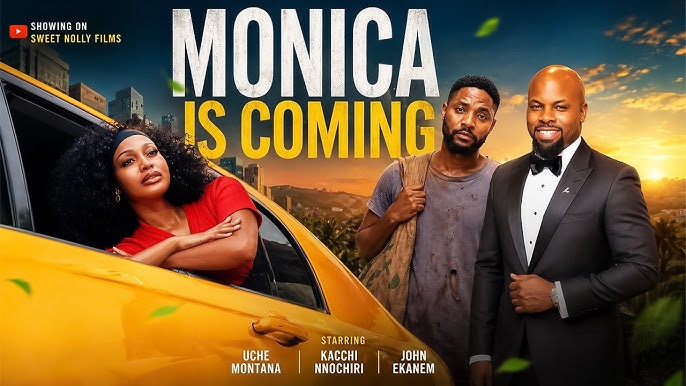
6 Million Views in 24 Hours: How Uche Montana’s “Monica 2” Broke the Internet and Became Nollywood’s Most Talked About Movie of 2026
Summary
Nollywood actress and filmmaker Uche Montana has achieved a remarkable digital milestone with Monica 2, the sequel to her hit film Monica, which was released on her YouTube channel on May 2/3, 2026. The film exploded to over 6 million views within 24 hours of release breaking records for her channel and outperforming the first part’s early numbers by a significant margin. The movie’s raw emotional storytelling center on a sacrificing firstborn daughter navigating family betrayal, parental irresponsibility, and the crushing weight of sibling duty has triggered a nationwide conversation, with millions of Nigerians saying the story is their own. Monica is the purest expression yet of digital Nollywood’s growing power to move people, drive social media conversations, and build cultural moments without a cinema release in sight.
At approximately 6 PM on May 2, 2026, Uche Montana uploaded Monica 2 to her YouTube channel. What followed in the next 24 hours was not a movie release it was a cultural event. Within a single day, the film had been watched over 6 million times, a figure that shattered records for Montana’s channel and sent her name trending across X, Instagram, and WhatsApp groups in Nigeria and across the Nigerian diaspora. Viewers were not just watching. They were weeping, ranting, sharing clips, tagging family members, and posting reactions that ranged from tearful testimonials to furious commentary about the parent characters.
This is the Monica moment Nigeria did not see coming and it has everything to do with what Uche Montana has built, both as a storyteller and as a filmmaker who understands her audience with rare precision.
The Monica story follows a young woman who is the firstborn of her family a role that in many Nigerian households is less a position of privilege and more a burden of unspoken sacrifice. Monica sells pap. She supports her siblings financially and emotionally. She navigates a largely absent or irresponsible father and a difficult mother whose expectations exceed her appreciation. There is no fantasy, no aspirational wealth, no crime thriller just the interior world of a Nigerian family laid bare with enough specificity that millions of viewers have said, with striking unanimity, “this is my story.”
That identification is what has made Monica more than a film. The comment sections under the YouTube videos read like a collective national therapy session. Viewers are processing their own childhoods through Monica’s story the eldest daughter who gave up her dreams to keep the house running, the son who sent money home while his siblings spent it freely, the parents whose love was conditional and whose gratitude arrived late if at all. The themes of firstborn burden, family betrayal, and the asymmetry of sacrifice in Nigerian homes are not new subjects. But Montana has given them a face, a name, and a narrative that feels personal rather than instructional.
The performances have drawn particular praise. Montana herself has been lauded for a portrayal that carries the film’s emotional weight with a naturalism that does not tip into melodrama a difficult balance in a genre where emotional extremity is sometimes mistaken for depth. The supporting cast, particularly the actors playing the mother and father, have been recipients of a specific kind of audience anger that is reserved for performances so convincing that viewers forget they are watching fiction. Calls for Monica’s parents to be held accountable have flooded comment sections with the earnest fury of people responding to real events.
Montana has been active on Instagram reacting to the outpouring of love, sharing viewer testimonials and responding to the emotional responses her work has generated. For a filmmaker who self produces and self-distributes on YouTube, the engagement represents not just artistic validation but a commercial and strategic vindication. Digital Nollywood the ecosystem of YouTube first filmmakers who have built massive audiences outside the traditional cinema release model has produced stars and moments before, but few have generated this kind of numbers this quickly.
Six million views in 24 hours, on a self-published YouTube channel, for a Nollywood sequel that deals with pap selling and parental disappointment. That sentence alone tells you everything about where Nigerian storytelling is going.
Analysis
The Monica phenomenon is a story about two things simultaneously the power of a specific kind of storytelling, and the remarkable infrastructure that digital Nollywood has built for delivering it. Uche Montana did not need a cinema chain, a distribution deal, or a marketing budget to reach 6 million people in a day. She needed a YouTube channel, a story that told the truth, and an audience that was ready to receive it. All three were in place when Monica 2 dropped on Friday evening. What Montana has understood and what the reaction to her film proves is that the most bankable currency in Nigerian popular culture right now is relatability. The Nollywood films that are generating the biggest cultural moments in 2026 are not the ones with the biggest production budgets or the most famous cast lists. They are the ones that make viewers feel seen. Monica makes millions of Nigerians feel seen in a very specific way: as people who gave more than they received, within families that asked everything and acknowledged little. The firstborn burden is one of the most universally experienced and least openly discussed realities of Nigerian family life. There is no official language for the eldest child who deferred education, who sent money home before keeping any, who mediated parental conflict, who became the parent when the parents could not. Monica has created that language and the 6 million people who watched in 24 hours are, many of them, people who have been waiting for it. What comes next for Montana and the Monica franchise — whether there will be a third part, a cinema release, or a streaming deal — is a conversation that Nigeria’s entertainment industry will be having in the coming weeks. But the more important conversation is the one already happening in comment sections, on X, and around dinner tables: about what Nigerian families ask of their firstborns, what they owe them, and whether those debts ever get paid.
Tags