Beyond the Battlefield: COAS Shaibu Reaffirms Nigerian Army’s Six Years King’s College London Partnership as Engine of Military Intellectual Transformation
Summary
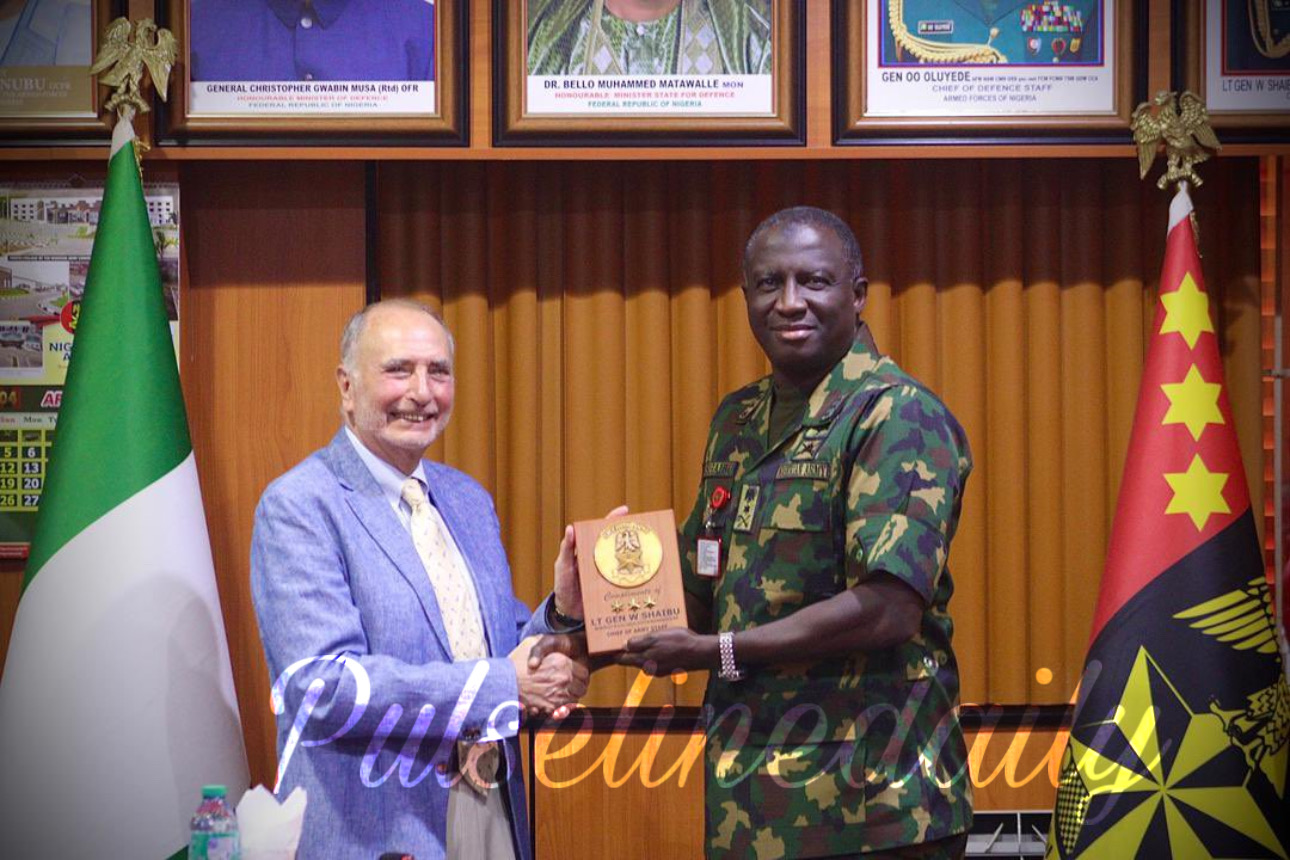
Chief of Army Staff Lieutenant General Waidi Shaibu on Wednesday, April 29, 2026, received a delegation from King’s College London led by Professor Randolph Charles Kent at Army Headquarters in Abuja, reaffirming Nigeria’s six years strategic partnership with the institution as a cornerstone of military capacity building, leadership development, and operational effectiveness. The COAS placed particular emphasis on the growing threat of information warfare and malign influence operations as emerging security frontiers requiring urgent academic and institutional collaboration. Professor Kent commended the Nigerian Army’s commitment to the Yale NARC African Leadership Centre programme, describing mutual knowledge exchange as vital to navigating modern security complexities.
In a globalised security environment where threats travel faster than bullets and information can be weaponised as effectively as any firearm, the Nigerian Army is making a deliberate investment in the one resource that no amount of hardware procurement can replace: intellectual capacity. Chief of Army Staff Lieutenant General Waidi Shaibu made that investment concrete on Wednesday by receiving a King’s College London delegation at Army Headquarters in Abuja and reaffirming a six years strategic partnership that has quietly become one of the most consequential academic military collaborations in Nigeria’s security architecture.
Lt Gen Shaibu described the partnership facilitated through the Nigerian Army Resource Centre as a strategic enabler in building intellectual capacity, leadership development, and operational effectiveness. He noted that the collaboration expands access to world class military education and supports the Army’s drive toward a more professional, adaptive, and combat ready force capable of operating within a joint and multi agency security framework. The NARC, which serves as the institutional bridge between the partnership’s academic outputs and the Army’s operational priorities, has functioned as a policy think tank generating ideas relevant to Nigeria’s evolving threat landscape.
The COAS was particularly pointed in his remarks on the digital information ecosystem a domain he identified as an increasingly urgent frontier for national security. Lt Gen Shaibu called for deeper academic and institutional collaboration to examine the implications of information warfare, malign influence operations, and the vulnerabilities associated with limited Nigerian control over the global information space. The call was notable for its candour: a serving COAS publicly acknowledging that Nigeria’s information environment represents a strategic vulnerability requiring proactive, research driven responses rather than reactive damage control.
The delegation was led by Professor Randolph Charles Kent, who commended the Nigerian Army for its sustained commitment to the partnership. Kent noted that the Yale NARC African Leadership Centre programme thrives on mutual knowledge exchange and shared expertise, describing such collaborations as vital to navigating global uncertainties and strengthening collective capacity to respond to complex security challenges. His remarks framed the partnership not as a donor recipient relationship but as a genuine intellectual exchange one from which both institutions draw value.
Analysis
The COAS’s emphasis on information warfare is the most strategically significant element of Wednesday’s engagement. Nigeria’s security conversation has long been dominated by kinetic threats insurgency, banditry, kidnapping, piracy and the Army’s institutional investments have correspondingly focused on firepower, mobility, and tactical doctrine. But the battlefield is expanding. Malign influence operations the deliberate use of disinformation, social media manipulation, and narrative weaponisation to destabilise governments, incite ethnic and religious conflict, and undermine public trust in state institutions are now as real a threat to Nigerian security as any armed group operating in the northeast or northwest. Lt Gen Shaibu’s call for academic collaboration to study these threats reflects an understanding that the Army cannot counter what it has not yet fully mapped or understood. King’s College London, with its established centres for defence studies and security analysis, is well placed to partner in that mapping exercise. The Yale NARC African Leadership Centre adds a further layer producing officers and analysts who are not just tactically competent but strategically literate, capable of thinking beyond the immediate engagement to the longer term security architecture Nigeria needs to build. Six years into this partnership, the question worth asking is whether its outputs are being systematically fed back into Army doctrine, training curricula, and policy recommendations or whether they remain at the level of papers and seminars that do not reach operational decision makers. Wednesday’s meeting, and the COAS’s personal engagement with the delegation, suggests an institutional leadership that is taking the intellectual dimension of national security seriously. That is the necessary condition for the partnership to matter. Whether it is the sufficient one remains to be demonstrated in the field.
Tags