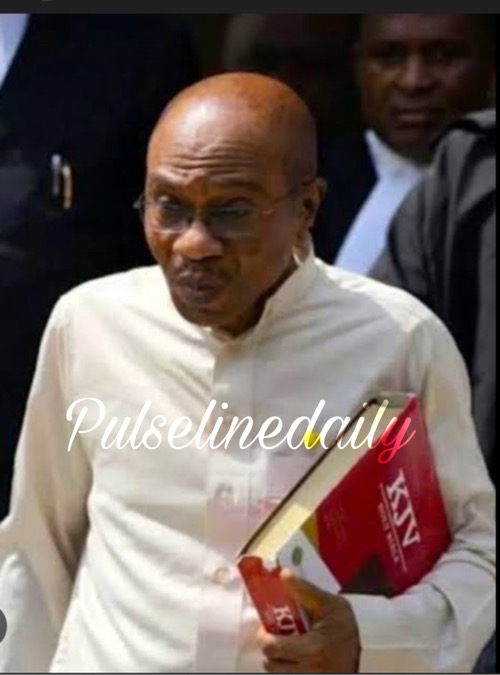
Forged Signatures, Phantom Observers, $6.23 Million: EFCC’s 13th Witness Delivers Damning Testimony Against Emefiele in CBN Fraud Trial
Summary
The criminal trial of former Central Bank of Nigeria Governor Godwin Emefiele reached a pivotal moment on Monday, April 27, 2026, as the 13th prosecution witness, EFCC investigator Chinedu Eneanya, testified before Justice Hamza Muazu of the FCT High Court in Maitama, Abuja. Eneanya told the court that $6.23 million was removed from the CBN vault under the guise of funding foreign election observers for the 2023 general election and that forensic analysis confirmed the authorising documents bore forged signatures of former President Muhammadu Buhari and former SGF Boss Mustapha. Five CBN officials who signed an internal memo relating to the transaction have since been suspended by the bank. The matter was adjourned to Tuesday, April 28, 2026 for continuation of trial.
The trial of former Central Bank of Nigeria Governor Godwin Emefiele took a deeply consequential turn on Monday as a key EFCC investigator delivered testimony that placed fresh forensic weight behind allegations that have been building steadily before the FCT High Court since 2023. An EFCC witness told the FCT High Court in Maitama, Abuja, how $6.23 million was withdrawn from the vault of the Central Bank of Nigeria for a phoney election monitoring exercise during the 2023 general elections.
The witness, Chinedu Eneanya an Assistant Commander II of the EFCC testified as the 13th prosecution witness and was led in evidence by Director of Public Prosecutions of the Federation Rotimi Oyedepo, SAN. Eneanya told the court he was part of the team specifically assigned to investigate the allegations against Emefiele, and that the investigation had involved interviewing individuals connected to the movement of the funds, as well as recovering relevant authorisation documents directly from the CBN.
Eneanya stated: “The investigation revealed that the money of $6.23 million was removed from the coffers of the CBN for purported funding of the foreign observer of the 2023 election.” He added that the documents recovered during the investigation purported to show presidential and governmental authorisation for the release of the funds but that forensic examination told a very different story.
Investigations revealed that the signatures of former President Muhammadu Buhari and former SGF Boss Mustapha were forged to facilitate the collection of the money a conclusion that came to light after forensic examination was carried out on the authorising documents. The forensic confirmation is significant: it transforms what could otherwise be disputed as a matter of competing accounts into a scientifically established finding that specific individuals’ identities were fraudulently deployed to unlock funds from Nigeria’s apex bank.
Under cross-examination by defence counsel Matthew Burkaa, SAN, Eneanya disclosed a significant internal consequence that had already followed the investigation: five CBN officials who signed the internal memo relating to the transaction were subsequently suspended by the bank. The revelation is a double-edged development for both sides the defence may use it to argue that institutional culpability was distributed across multiple actors, while the prosecution will likely contend that such a wide chain of complicity could only have been set in motion at the highest level of the institution’s leadership.
A Pattern Established Across 13 Witnesses
Monday’s testimony does not stand alone it is the latest thread in a fabric of evidence that has been woven carefully across the trial’s earlier hearings. The 11th prosecution witness, Bashirudden Maishanu, an assistant director at the CBN, testified in January 2026 that the $6.23 million was withdrawn in cash from a CBN vault in a single day in February 2023. Maishanu told the court that he and others were subsequently given $2.5 million of the total sum, and that he found the amount outrageous, saying: “I thought it was a setup.” He further confirmed that the $6.2 million was never used for its stated purpose of funding foreign election observers.
The forgery allegation had been independently established at an even earlier stage. Boss Mustapha himself testified as the fourth prosecution witness, telling the court that both his signature and Buhari’s were forged by those who removed the $6.23 million from the CBN vault on February 8, 2023. Forensic expert Bamaiyi Meriga further told the court on March 7, 2024 that documents used to facilitate the withdrawal were forged providing independent scientific confirmation that has now been echoed by Eneanya’s own investigative team.
The Charges
The EFCC is prosecuting Emefiele on 20 amended counts including criminal breach of trust, forgery, obtaining by false pretence, conspiracy to commit forgery, procurement fraud, and conspiracy to commit a felony. The charges include the alleged fraudulent payout of $6.23 million from the CBN vault in Abuja in 2023 under the guise of payments for phoney foreign election observers’ expenses. Emefiele has vehemently denied all the charges.
Beyond the election observers’ funds, the EFCC also alleges that Emefiele conferred corrupt advantages on April 1616 Nigeria Ltd and Architekon Nigeria Ltd in contract awards a separate strand of alleged institutional abuse that the prosecution has also been developing across the trial.
Procedural Battle: Defence Pushes for Foreclosure
Monday’s session was not without sharp procedural tension. Burkaa applied to the court for the foreclosure of the prosecution’s case, should it fail to produce its remaining two witnesses at the next adjourned date citing what the defence described as a deliberate pattern of delay aimed at frustrating the defendant. The application was a pointed escalation, signalling that the defence has grown impatient with the pace of a trial that has spanned nearly three years.
Oyedepo opposed the application, explaining that the prosecution was not attempting to delay proceedings but was encountering genuine logistical challenges in securing the attendance of witnesses located in Benin City and Lagos outside the court’s immediate jurisdiction. He urged the court not to shut out the prosecution from presenting its complete case.
Justice Muazu, navigating carefully between both positions, declined to rule on the foreclosure application immediately, advising both parties to reserve their arguments for the stage of final addresses. He also directed the prosecution to liaise with the court registrar to ensure subpoenas are issued to facilitate the remaining witnesses’ appearance. The judge’s caution reflects a pattern of measured rulings in this trial he had previously imposed a N500,000 fine on the EFCC for repeated delays in March 2026 while still granting what he described as a final adjournment balancing the defendant’s right to a speedy trial against the prosecution’s need to present a complete case.
The matter was subsequently adjourned to Tuesday, April 28, 2026, for continuation of trial.
Analysis
There is a moment in long, complex corruption trials when the weight of accumulated evidence reaches a tipping point when what began as allegations becomes, through the convergence of witness testimony, documentary evidence, and forensic analysis, something far more difficult to dismiss. The Emefiele trial may be approaching that moment. Thirteen prosecution witnesses have now testified. Multiple strands of evidence from the testimony of the SGF himself, to a forensic expert’s confirmation of document forgery, to a CBN insider’s admission that the money was never applied to its stated purpose point in the same direction with remarkable consistency. Chinedu Eneanya’s testimony on Monday matters not just for its content but for its position in the prosecution’s narrative architecture. As an investigator, he occupies a different evidentiary role from the witnesses who preceded him. Where earlier witnesses spoke to what they saw, did, or were told, Eneanya speaks to what the investigation formally established including the conclusions of forensic analysis. That distinction gives his account a particular authority before the court, and it is unlikely to be easily dismantled in cross-examination without the defence identifying specific procedural failures in the investigation itself. The suspension of five CBN officials over the internal memo is one of the most significant details to emerge from Monday’s proceedings. It raises a question the court will ultimately have to answer: how does an operation of this scale the withdrawal of over $6 million in cash from Nigeria’s central bank vault in a single day, using forged presidential documents occur without the knowledge and direction of the institution’s governor? The prosecution’s case rests on establishing that it could not have. The defence’s case rests on casting sufficient doubt on that proposition to prevent conviction beyond a reasonable doubt. What is not in doubt is the broader significance of the trial for Nigeria’s institutions. The allegation that the CBN the guardian of Nigeria’s monetary sovereignty was used as a personal instrument for political financing, with the identity of a sitting president fraudulently invoked to unlock the funds, is among the most serious institutional corruption allegations in the country’s recent history. Whether Emefiele is ultimately convicted or acquitted, the trial has already revealed something important: that the internal controls of Nigeria’s most powerful financial institution failed catastrophically in February 2023, and that the failure was not accidental.
Tags