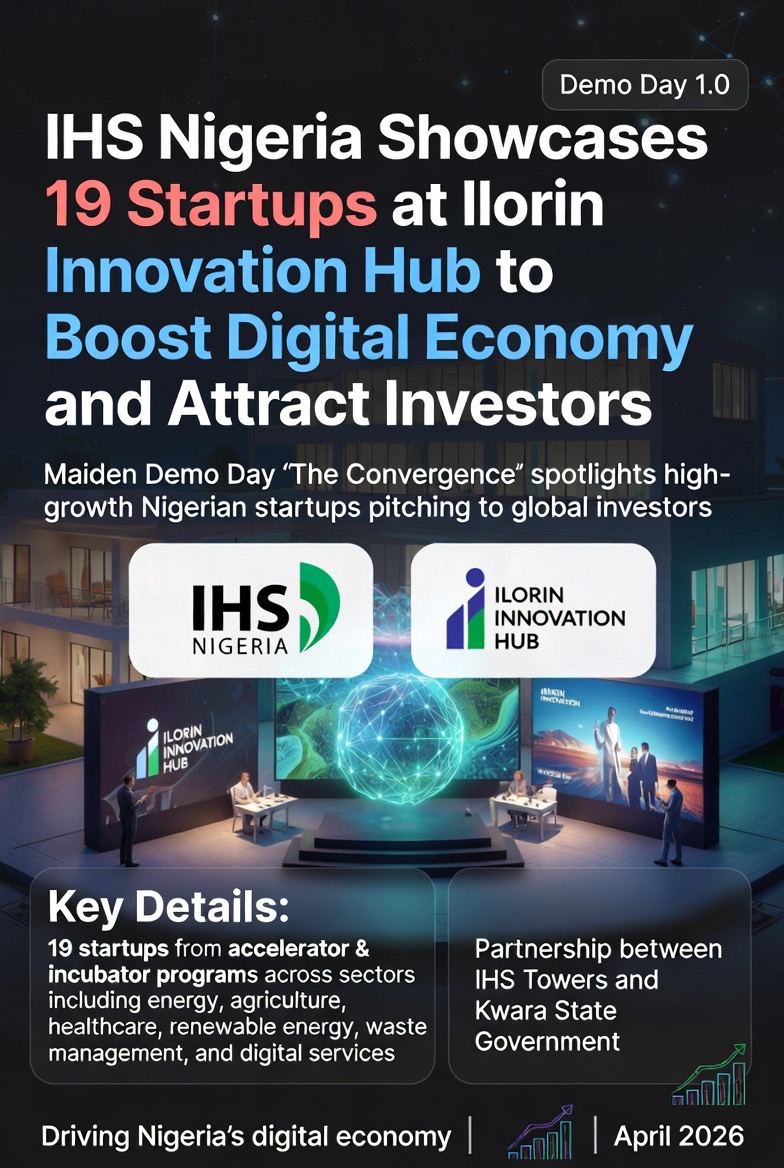
IHS Nigeria Showcases 19 Startups at Ilorin Innovation Hub to Boost Digital Economy and Attract Investors
Summary
IHS Nigeria has strengthened its commitment to Nigeria’s digital economy by showcasing 19 high-growth startups at the Ilorin Innovation Hub Demo Day. The startups, drawn from incubation and accelerator programmes, pitched solutions across sectors such as agriculture, health-tech, energy, and digital services to attract local and international investors. The initiative is part of broader efforts to boost innovation, job creation, and entrepreneurship in Nigeria’s tech ecosystem.
IHS Nigeria, a major infrastructure and digital ecosystem enabler in the country, has continued its push to deepen Nigeria’s digital economy through startup development and innovation support.
At a recent Demo Day held at the Ilorin Innovation Hub in Kwara State, the company showcased 19 startups that have gone through structured incubation and acceleration programmes. The event brought together investors, venture capital firms, corporate partners, and public sector stakeholders to evaluate emerging solutions from Nigerian innovators.
The initiative is part of a collaboration between IHS Nigeria and the Kwara State Government aimed at building a strong innovation ecosystem that supports early-stage startups with mentorship, technical training, and access to funding opportunities.
The showcased startups operate across multiple sectors, including:
* Agriculture technology (agritech)
* Healthcare innovation (health-tech)
* Renewable and green energy
* Digital platforms and services
* Infrastructure and sustainability solutions
According to information from the event, the startups were selected from a wider pool of participants in the hub’s incubation and accelerator programmes, designed to help transform ideas into commercially viable businesses.
Analysis
Impact on Nigeria’s Digital Economy 1. Expanding innovation beyond major cities A key impact of the Ilorin Innovation Hub is decentralisation. By building innovation infrastructure outside Lagos, it reduces regional imbalance and opens opportunities for talent in underserved areas. 2. Startup-to-investor pipeline strengthening The Demo Day model creates a direct link between startups and investors, helping reduce one of the biggest challenges in Nigeria’s tech ecosystem—access to funding. 3. Job creation potential With multiple startups focused on scalable tech solutions, the programme supports long-term job creation in digital services, engineering, agriculture, and renewable energy sectors. 4. Foreign and local investor confidence By showcasing structured, market-ready startups, initiatives like this improve investor confidence in Nigeria’s innovation ecosystem, which is essential for long-term capital inflow. 5. Long-term digital transformation Beyond funding, the broader goal is to build a sustainable pipeline of tech entrepreneurs capable of solving real-world problems and contributing to Nigeria’s digital transformation agenda.