INEC Opens Ad-Hoc Staff Recruitment Portal for 2026 Ekiti Governorship Election How to Apply Before May 18 Deadline
Summary
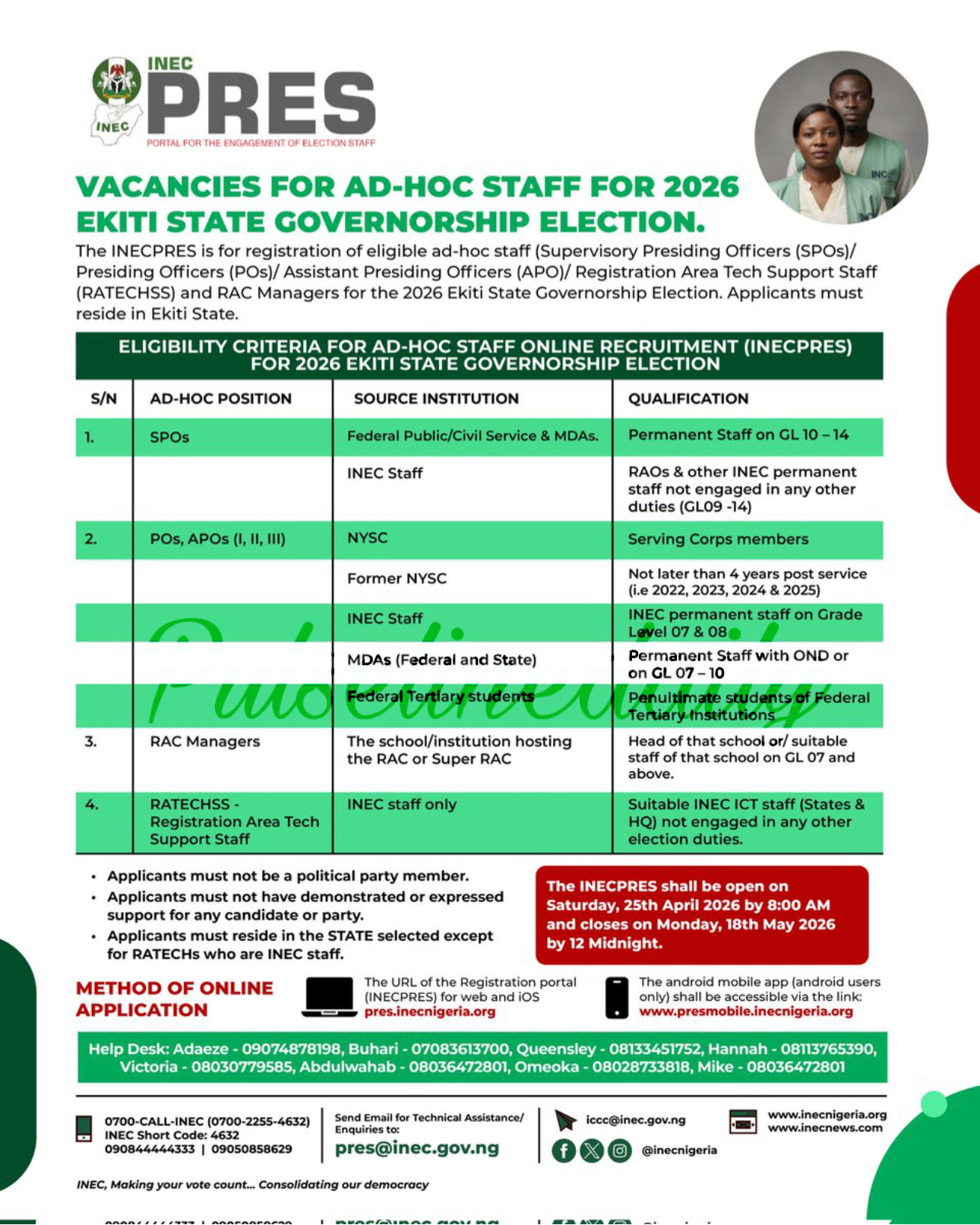
The Independent National Electoral Commission (INEC) has officially opened applications for ad-hoc election staff to support the Ekiti State Governorship Election scheduled for June 20, 2026. Four categories of positions are available Supervisory Presiding Officers (SPOs), Presiding Officers and Assistant Presiding Officers (POs/APOs), Registration Area Centre (RAC) Managers, and Registration Area Technical Support Staff (RATECHs). The application portal opened on April 25 and closes on May 18, 2026, and is accessible at pres.inecnigeria.org.
Nigeria's electoral body has taken a significant step in its preparations for one of the most closely watched off-cycle elections of 2026. The Independent National Electoral Commission (INEC) has commenced the recruitment of ad-hoc staff for the Ekiti State Governorship Election scheduled for Saturday, June 20, 2026.The announcement, made via INEC's official social media channels on Sunday, marks the beginning of the human resource mobilisation phase of an election that will serve as a critical early test of Nigeria's electoral infrastructure in the current election cycle.
Applications are open for four key positions: Supervisory Presiding Officers (SPOs), Presiding Officers and Assistant Presiding Officers (POs/APOs), Registration Area Centre (RAC) Managers, and Registration Area Technical Support Staff (RATECHs). The application portal opened on April 25, 2026, and will close on May 18, 2026. Eligible Nigerians are encouraged to apply promptly through the official portal at pres.inecnigeria.org.
INEC has laid out specific eligibility criteria for each category of position. For the SPO role, applicants must be public or civil servants on Grade Levels 10 to 14, or Registration Area Officers and INEC staff not engaged in other duties on the same grade levels.Those applying for the PO and APO positions must be serving corps members, penultimate students of a federal or state tertiary institution in Nigeria with a knowledge of IT, permanent staff of a Ministry, Department, or Agency with an OND qualification or on Grade Levels 07 to 10, INEC permanent staff on Grade Levels 07 and 08, or former corps members who completed service no earlier than 2023.
For the RATECH category, applicants must have an IT background and must be suitable INEC ICT staff either at the state or headquarters level not engaged in any other duties. This technical category is essential to INEC's deployment of the Bimodal Voter Accreditation System (BVAS) and other digital electoral tools that have become central to Nigeria's election management in recent years.
INEC has also outlined strict neutrality requirements that cut across all positions. Applicants must not be political party members or have expressed support for any candidate or party, and must reside in the state selected for deployment except for RATECHs. Returning applicants are advised to enrol based on the appropriate category that currently applies to them at the time of application.
The recruitment drive forms part of INEC's preparations for the off-cycle Ekiti governorship poll, where incumbent Governor Biodun Oyebanji is seeking re-election. Ekiti State has historically been a competitive political battleground, and the 2026 election is expected to attract significant attention from political parties, civil society groups, and election observers across Nigeria.
Beyond Ekiti, INEC's broader 2026-2027 election calendar is already taking shape. The commission has scheduled the Osun Governorship Election for August 15, 2026, while the Presidential and House of Assembly Elections are set for January 16, 2027, and the Governorship and State House of Assembly Elections for February 6, 2027. The Ekiti recruitment exercise is therefore the first major logistical mobilisation ahead of what will be an exceptionally busy electoral season for Nigeria.
Prospective applicants who have previously registered on the INEC portal are advised to log in and update their profiles, while first-time applicants should register afresh. All applications must be completed online; the commission does not accept manual or walk-in applications for ad-hoc staff positions.
Analysis
INEC's decision to open its ad-hoc staff recruitment portal nearly two full months before the June 20 Ekiti Governorship Election reflects a conscious effort to build operational readiness early and that instinct deserves recognition. One of the persistent criticisms that has dogged Nigerian elections in recent cycles is the lastminute scramble to recruit, train, and deploy election workers, a pattern that has contributed to logistical failures, ballot delays, and compromised accreditation processes in several states. An early opening of the application window, with a firm May 18 closing date, suggests INEC is attempting to front-load the administrative burden before the heat of the campaign season fully sets in. The eligibility criteria themselves are worth examining closely. The inclusion of corps members and penultimate students as eligible PO and APO candidates is a long standing INEC practice rooted in practical necessity Nigeria's tertiary institutions supply a large, relatively educated, and geographically distributed pool of temporary workers that the commission would struggle to replace from the public service alone. However, it is a practice that has also attracted scrutiny, with critics arguing that young, inexperienced staff are more vulnerable to intimidation by political actors and less equipped to handle confrontational situations at polling units. How INEC trains and supports this cohort before election day will matter as much as how it recruits them. The neutrality requirement barring party members and those who have publicly supported any candidate is constitutionally and procedurally sound, but enforcement has historically been the weak link. Nigeria's political environment, particularly in a state like Ekiti with deep partisan loyalties, makes it genuinely difficult to guarantee that every ad-hoc staff member arrives on election day without political sympathies. INEC's real challenge is not writing the policy, but building the verification and monitoring architecture that makes the policy meaningful in practice. The Ekiti election also carries national implications. As one of only two off-cycle gubernatorial elections in 2026, it will be watched closely by all major parties as an indicator of grassroots strength ahead of the 2027 general elections. The integrity of the ad-hoc recruitment process who gets selected, who gets deployed, and who gets to decide is therefore not just an administrative question. It is a political one. INEC's conduct of this exercise will either reinforce confidence in the commission as an impartial institution or deepen existing suspicions. The portal is open. The process has begun.
Tags