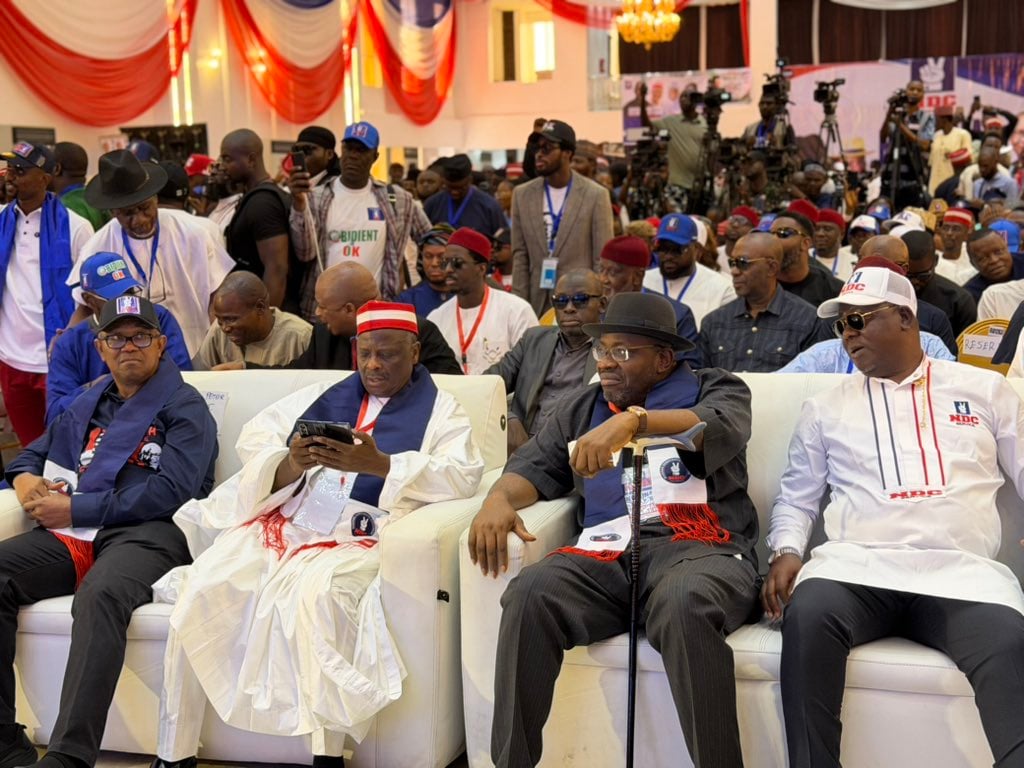
One Term, One South, One Deal — NDC Convention Locks In Zoning Formula as Peter Obi's Path to 2027 Clears
Summary
The Nigeria Democratic Congress has made its most consequential political decision since its registration formally zoning its 2027 presidential ticket to Southern Nigeria for a single four-year term, with an automatic rotation to the North in 2031. The resolution was adopted at the party's maiden National Convention held at the Los Angeles Event Centre in Abuja on Saturday, following a motion moved by Afam Victor Ogene, member representing Ogbaru Federal Constituency of Anambra State in the House of Representatives, and unanimously adopted by delegates. Rabiu Musa Kwankwaso, who attended the convention alongside Peter Obi, publicly endorsed the arrangement describing it as "a true opportunity for national healing" and pledging full compliance with the party's rotational agreement.
It was the motion that changed everything. And it came from Anambra.
Afam Victor Ogene, the member representing Ogbaru Constituency in the 10th House of Representatives, rose at the NDC's maiden National Convention on Saturday and moved a motion to formally zone the party's 2027 presidential ticket to Southern Nigeria for a single four year term. The delegates didn't deliberate for long. The hall erupted in agreement almost immediately and when the vote came, it was unanimous.
Just like that, the political terrain shifted.
The resolution does two things simultaneously: it clears the path for Peter Obi and any other southern aspirant to purchase the NDC's presidential nomination form and contest the primaries and it makes a binding commitment to the North that in 2031, the ticket returns automatically. It is, in effect, a written power sharing contract dressed in the language of convention resolution. Nigeria has seen these kinds of informal arrangements fail before. The NDC is betting that putting it on record, at a convention, with delegates witnessing, gives it a durability that verbal agreements never could.
The convention also ratified the full list of the party's National Executive Committee, following a motion moved by Senator Victor Umeh, who represents Anambra Central consolidating the party's internal governance structure at the same session where its presidential zoning was formalised. In one afternoon, the NDC did what took the PDP years it built a leadership architecture and a presidential roadmap in the same sitting.
Kwankwaso's endorsement was the moment the room understood how serious this all was. "It is with great sense of unity and solidarity that as a loyal party member, I support the decision to zone the presidential ticket of the NDC to the South, so that it allows the region to complete its turn in producing national leadership," the former NNPP presidential candidate told the gathering. It wasn't reluctant. It wasn't hedged. A northern political heavyweight just endorsed a southern presidential ticket publicly, on the record, at a national convention. That is not nothing.
Peter Obi, for his part, used the convention platform to deliver one of his sharpest assessments yet of Nigeria's condition. "Nigeria is not a poor country; it is a country rooted in poverty by poor leadership and governance," he declared, adding that over 140 million Nigerians currently live in multidimensional poverty while millions of young people remain locked out of meaningful employment. He promised that an NDC government would pursue policies aimed at transforming Nigeria from a consumption based economy into a production-driven one, while restoring national security and public trust in governance. It was campaign language. Deliberate, pointed, and very much aimed at 2027.
The NDC has been quietly gathering momentum in the National Assembly, with several lawmakers defecting from both the House of Representatives and the Senate in recent months strengthening its legislative presence ahead of the election cycle. National Chairman Senator Moses Cleopas, in his welcome address, described the convention as a defining moment telling delegates: "We are not assembling a crowd for elections; we are building a movement for governance." The distinction matters. Whether it holds will be the test of everything that follows.
The zoning decision comes in the context of President Tinubu's southern presidency, which began in 2023 following Muhammadu Buhari's eight year tenure from the North making the NDC's south-first arrangement both politically logical and strategically timed.
Analysis
The NDC did something in Abuja on Saturday that Nigeria's opposition has been trying and failing to do for years: it made a clear, public, binding decision about power who gets it, when, and for how long before the campaign even formally begins. That sounds simple. It isn't. The history of Nigerian political zoning is a history of agreements made in private, disputed in public, litigated in court, and ultimately abandoned whenever they became inconvenient for whoever held power at the moment. The PDP's zoning arrangement collapsed spectacularly in 2011. The APC never truly had one. The NDC's version, passed at a convention with delegates, witnesses, and cameras, is structurally harder to walk back. Harder not impossible. But harder. The single four year term provision is the most radical element here, and it deserves more scrutiny than it has received in the initial wave of reporting. A party that zones its presidential ticket to the South and simultaneously commits its candidate to only one term is doing two things at once. It is telling northern supporters particularly Kwankwaso's Kwankwasiyya base that their wait will be short: four years, not eight. And it is telling southern supporters, particularly Obi's Obidient movement, that this presidency, if it comes, will be a rescue mission rather than a dynasty. Whether Peter Obi, if he wins, would actually be constitutionally or politically bound to serve only one term is another matter entirely. The constitution allows two terms. A party resolution does not override that. But the political signal being sent is clear enough. What this convention did, above all else, is confirm that the NDC is now the most consequential new political platform in Nigeria. In three months from INEC registration in February to a zoned presidential ticket with a national convention ratification in May Seriake Dickson has built something that took other parties years to approximate. The APC will mock it. The PDP will dismiss it. And Tinubu's campaign machinery will study it very carefully, because a united south-north opposition coalition Obi for the south, Kwankwaso for the north, Dickson's structure holding it together is exactly the configuration that keeps APC strategists up at night. The road to 2027 is long and in Nigeria, it is rarely straight. But on Saturday in Abuja, the NDC drew the most detailed map of it yet.
Tags