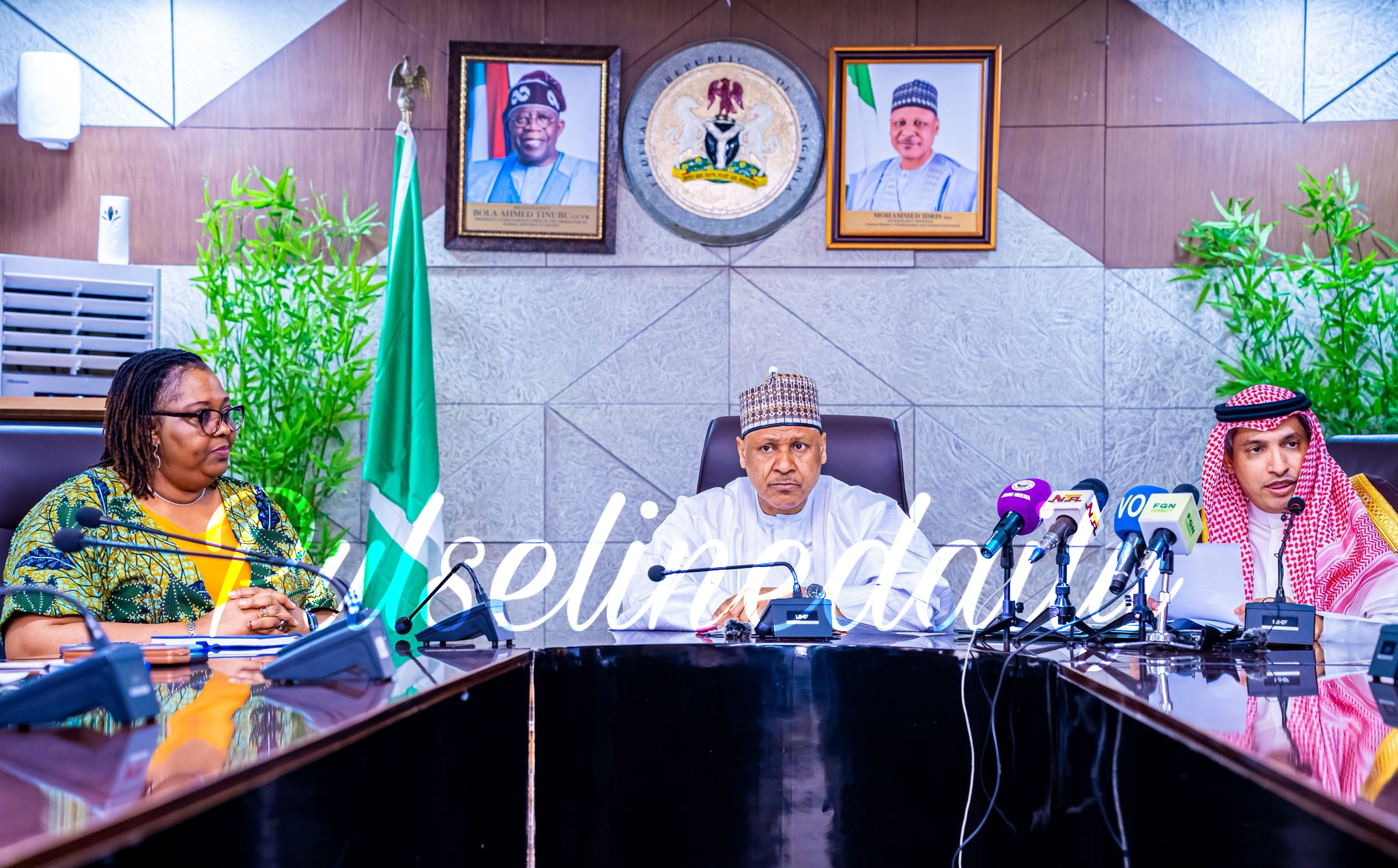
Scholarships, Flights, and Solidarity: Minister @HMMohammedIdris Receives Saudi Ambassador AlBalawi in Abuja, Deepening Nigeria-Saudi Bilateral Ties
Summary
Nigeria’s Minister of Information and National Orientation, Mohammed Idris (@HMMohammedIdris), on Monday, April 27, 2026, received the Ambassador of the Kingdom of Saudi Arabia to Nigeria, Yousef bin Mohammed AlBalawi, on a courtesy visit at the Federal Ministry of Information headquarters in Abuja. The meeting produced significant diplomatic outcomes including Nigeria’s commendation of Saudi Arabia’s 50 students petroleum scholarship initiative, a reaffirmation of bilateral cooperation across media, economy, security, and religious affairs, and a call by Minister Idris for the full implementation of pending Memoranda of Understanding between both countries, including in broadcasting. Ambassador AlBalawi also conveyed Saudi Arabia’s appreciation to President Bola Tinubu for Nigeria’s solidarity during ongoing Gulf tensions, while discussions touched on the anticipated resumption of direct Saudi airline flights between Jeddah and Abuja.
In a meeting that spanned diplomacy, education, energy, and the enduring bonds of faith and history, Nigeria’s Minister of Information and National Orientation, Mohammed Idris (@HMMohammedIdris), on Monday welcomed the Saudi Arabian Ambassador to Nigeria, Yousef bin Mohammed AlBalawi, to his office in Abuja for a wide-ranging courtesy visit that underscored the depth and evolving character of Nigeria-Saudi Arabia bilateral relations.
Minister Idris received Ambassador Yousef Bin Mohammed Al Balawi during a courtesy visit to his office in Abuja on Monday, April 27, 2026. The visit, the ambassador’s second to the minister’s office this year following an earlier engagement in February, reflects the growing frequency and substance of high-level diplomatic exchanges between Africa’s most populous nation and the Arab world’s largest economy.
Petroleum Scholarships: A Strategic Investment in Nigeria’s Future
The centrepiece announcement of Monday’s meeting was Saudi Arabia’s offer of 50 scholarships to Nigerian students in the petroleum sector. The Federal Government described the gesture as a strategic investment in Nigeria’s human capital development and a reflection of strong bilateral relations between both countries.
Minister Idris expressed Nigeria’s deep appreciation for the scholarship initiative, noting that it aligns with the Federal Government’s priority to strengthen critical sectors of the economy through capacity building. “This is not just a scholarship programme; it is a strategic investment in Nigeria’s future, particularly in key sectors such as petroleum and solid minerals that are central to our economic growth and diversification,” the Minister stated. He highlighted the significance of the initiative, noting that the programme is expected to be sustained annually, thereby creating a long term impact.
The scholarships land at a particularly timely moment. Nigeria’s petroleum sector is undergoing one of the most significant restructuring periods in its history from the Petroleum Industry Act reforms to the growing ambitions of NNPC Limited’s upstream subsidiaries and developing a cadre of highly trained petroleum engineers and technical specialists is a stated government priority. A sustained annual scholarship programme with one of the world’s leading oil economies directly addresses that human capital gap.
MoUs, Media, and the Misinformation Challenge
Minister Idris committed the government to deepening the bilateral partnership and ensuring that existing agreements, including pending Memoranda of Understanding in broadcasting and other sectors, are fully implemented for mutual benefit. The reference to pending MoUs in broadcasting is particularly notable it signals that Nigeria and Saudi Arabia have existing frameworks for media cooperation that have not yet been fully activated, and that the Tinubu administration views their implementation as a priority.
The media dimension of the bilateral relationship was also directly addressed by Ambassador AlBalawi. He noted that he would work with the ministry and the media to address misinformation about Saudi Arabia and project a more accurate image of the country, adding: “We share the same values and also have a historical relationship with Nigeria.” The Ambassador expressed Saudi Arabia’s desire to strengthen collaboration with Nigeria in strategic areas, including economy, security, media, and political relations, and stated: “Saudi Arabia is eager to work closely with Nigeria to strengthen cooperation in media, economy, security, and religious affairs, while also ensuring that accurate and constructive information about our country is shared through strong institutional partnerships.”
The emphasis on countering misinformation reflects a broader communications challenge that Saudi Arabia has faced internationally in recent years and the decision to engage Nigeria’s Ministry of Information directly as a partner in that effort is both strategically considered and diplomatically significant. Nigeria’s media landscape is large, influential, and reaches audiences across the African continent and the diaspora.
Solidarity Amid Gulf Tensions
One of the most diplomatically significant moments of the meeting came when Minister Idris addressed the current tensions in the Gulf region. The Minister conveyed Nigeria’s solidarity with Saudi Arabia, stating: “Let me also take this opportunity, on behalf of the Federal Government of Nigeria, to express our solidarity with the Kingdom of Saudi Arabia at this time of tensions in the Gulf region. We sincerely hope for continued peace, stability, and diplomatic resolution of all issues.”
Ambassador AlBalawi conveyed the Saudi leadership’s appreciation to President Bola Tinubu for Nigeria’s solidarity, describing it as a reflection of the strong relations between both countries. Nigeria’s public alignment with Saudi Arabia’s position amid Gulf tensions represents a meaningful diplomatic signal one that reflects the depth of the bilateral relationship and Nigeria’s broader orientation in its engagement with the Arab world.
Flights, Hajj, and People to People Connections
The Minister expressed appreciation for Saudi Arabia’s continued support in facilitating Hajj and Umrah operations for Nigerian pilgrims a dimension of the bilateral relationship that directly touches the lives of millions of Nigerian Muslims annually. Nigeria is consistently among the largest sources of Hajj pilgrims globally, and the logistical and diplomatic cooperation required to support that pilgrimage is a significant and ongoing feature of the two countries’ relationship.
Ambassador AlBalawi also indicated that Saudi airlines will resume flight operations between Jeddah and Abuja in June 2026 or by January 2027 a development that would significantly ease travel between Nigeria and the Kingdom for both religious and commercial purposes. The Minister welcomed discussions around the possible resumption of direct flights between Jeddah and Abuja, describing it as a development that would further boost people-to-people connections, tourism, and economic exchange.
Minister Idris described the visit as a strategic step toward deepening institutional collaboration between both countries, emphasising that Nigeria values its longstanding relationship with Saudi Arabia and is committed to expanding cooperation across key sectors. He stated: “Nigeria will continue to strengthen bilateral relations with the Kingdom of Saudi Arabia through enhanced cooperation in media, communication, economy, and security.” A follow up meeting between the Minister and his Saudi counterpart is expected to be scheduled to advance the implementation of the agreements discussed.
Analysis
Monday’s courtesy visit between @HMMohammedIdris and Ambassador AlBalawi is deceptively significant. On the surface, it reads as a routine diplomatic call warm words exchanged, bilateral friendship reaffirmed, a scholarship announced. But examined more carefully, the substance of what was discussed reveals a bilateral relationship that is actively maturing across multiple strategic dimensions simultaneously: energy, media, religious affairs, air connectivity, and geopolitical solidarity. The petroleum scholarship initiative is the most immediately tangible outcome, and it deserves to be understood as more than a goodwill gesture. Saudi Arabia is a global petroleum powerhouse with world class training institutions and deep industry expertise. Offering fifty Nigerian students annual access to that knowledge base is an investment in Nigeria’s technical capacity at precisely the moment when Nigeria needs it most as NNPC Limited transitions toward commercial rigour, as indigenous production capacity is being rebuilt, and as the country pushes to develop its solid minerals sector. If the programme is implemented annually and consistently as promised, its cumulative impact over a decade could be measurable in the careers of hundreds of Nigerian petroleum professionals. The media cooperation dimension is equally significant but less discussed. Nigeria’s Ministry of Information partnering with Saudi Arabia to counter misinformation and build accurate narratives about the Kingdom is a form of soft power engagement that serves both parties. For Saudi Arabia, it gains a trusted communication partner in one of the world’s most consequential Muslim-majority countries. For Nigeria, it deepens institutional relationships with a partner that has significant influence in Islamic affairs globally influence that touches everything from theological discourse to Hajj logistics to development finance through institutions like the Islamic Development Bank. The expression of solidarity with Saudi Arabia during Gulf tensions is perhaps the most diplomatically charged element of Monday’s meeting. By speaking those words publicly on behalf of the Federal Government Minister Idris has signalled Nigeria’s posture in a geopolitical context that extends far beyond the bilateral. It positions Nigeria clearly within a framework of solidarity with Riyadh at a sensitive moment, and Ambassador AlBalawi’s decision to convey his leadership’s appreciation directly to President Tinubu indicates that the signal was received and valued at the highest levels of the Saudi government. These are the quiet but consequential gestures from which the architecture of long-term strategic partnerships is built.
Tags