Sixteen Die on the Jos-Lagos Run: How a Tired Driver and an Unforgiving Bridge Turned the Lokoja-Okene Highway Into a Morgue
Summary
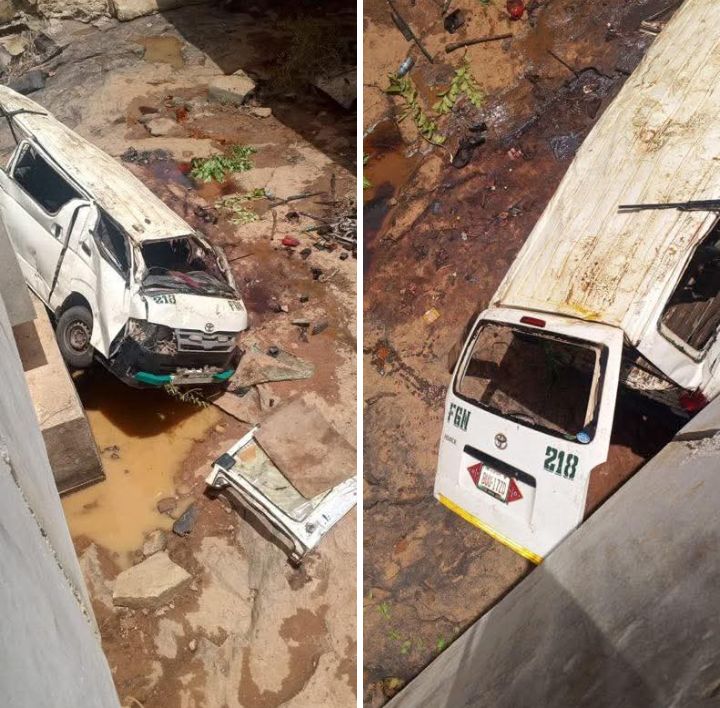
Sixteen people are dead and six others are fighting for their lives after a commercial Toyota Hiace bus plunged off a bridge on the Lokoja-Okene highway in Kogi State on Friday morning, May 8, 2026. The crash occurred at approximately 9:20 a.m. at Aku village near Osara, when the bus with registration number BUU 17 ZD veered off the road at high speed and plunged under a bridge, killing sixteen of its twenty two occupants on the spot. Kogi State Sector Commander of the Federal Road Safety Corps, Corps Commander Lawan Fagge, confirmed that preliminary findings from survivors pointed to driver fatigue and excessive speeding as the primary causes of the crash.
Twenty two people boarded a bus in Jos on Thursday night. Sixteen of them would never reach Lagos.
The Toyota Hiace bus registration number BUU 17 ZD was carrying 22 passengers, 21 men and one woman, on a long distance commercial run from Jos, Plateau State, to Lagos when it met its end at Aku village, near Osara on the Lokoja-Okene highway. The time was 9:20 Friday morning. The road was busy. And somewhere between a night of driving and an approaching bridge, the driver lost control.
According to the FRSC's account, the vehicle was travelling at excessive speed when the driver fatigued from hours behind the wheel was unable to maintain control of the bus. It veered off the road and plunged under a bridge. The impact was catastrophic. There were no seat belts that could have helped. No barrier that caught them. Just the sudden, violent end of a journey that had started hours earlier in the north.
Sixteen occupants died at the scene fifteen men and the only female passenger on board. Six survived. But survival, on this occasion, came with its own cost. One critically injured victim was rushed to the Specialist Hospital in Lokoja for advanced care, while five other injured passengers were admitted to Osara Hospital, where they are currently receiving treatment. The bodies of the dead were deposited at the Ankuri Mortuary in Lokoja. FRSC rescue teams from the Zariagi Unit responded to a distress call and arrived at the scene to evacuate survivors and clear the wreckage. The Okene-Lokoja stretch is widely recognised as one of the busiest transit corridors in the country connecting northern states to southern Nigeria and is frequently the site of accidents involving long distance commercial drivers navigating its hilly terrain through the night and into the early morning.
This is not an isolated tragedy. It is the latest entry in a record that keeps getting longer. The FRSC reaffirmed its commitment to reducing road traffic crashes through ongoing "Safe-to-Load" programmes and highway patrols and urged motorists, as it always does after accidents like this, to observe speed limits, rest adequately, and comply with traffic regulations. The words are familiar. The deaths keep coming anyway.
Analysis
Sixteen people left Jos alive on Thursday night. They had plans. Families expecting them. Reasons to be in Lagos. And by Friday morning, at a bridge over a gully in Aku village, all of it was gone not because of war, not because of illness, but because a driver was too tired to hold a steering wheel and too fast to survive a mistake. That's the thing about road deaths in Nigeria that the statistics can never fully capture. They are almost always preventable. Fatigue is not a mechanical failure. Speeding is not an act of God. They are choices sometimes desperate, sometimes careless, almost always the product of a transport system that puts impossible pressure on commercial drivers to cover long distances without adequate rest, without enforced stops, and without any meaningful accountability until the bus is already under a bridge. The Lokoja-Okene highway has a reputation. Ask any long-distance driver who works the Jos-Lagos corridor and they'll tell you about Osara, about the hills, about the way the road bends in places that punish inattention. The FRSC knows it too which is why the Zariagi Unit exists along that stretch. But knowledge of a dangerous road and preventing deaths on that road are two very different things. What is needed, urgently, are enforced rest stops at departure points for night buses, mandatory fitness to drive checks before long distance commercial vehicles hit the road, and real consequences not just advisories for transport operators who allow fatigued drivers to carry passengers across state lines in the dark. The one woman on that bus. She was the only female among twenty two passengers. Her name has not been released. None of the sixteen names have been released yet. They are, for now, a number and numbers, in Nigeria's road safety conversation, have a way of fading quickly. By next week there will be another highway, another crash, another FRSC statement with the same language about speed limits and driver fatigue. The cycle will continue until the system that produces it is changed. Not reformed at the margins. Changed. Sixteen families are grieving tonight. The Lokoja-Okene road will be busy again tomorrow morning. That is the quiet horror of all of this.
Tags