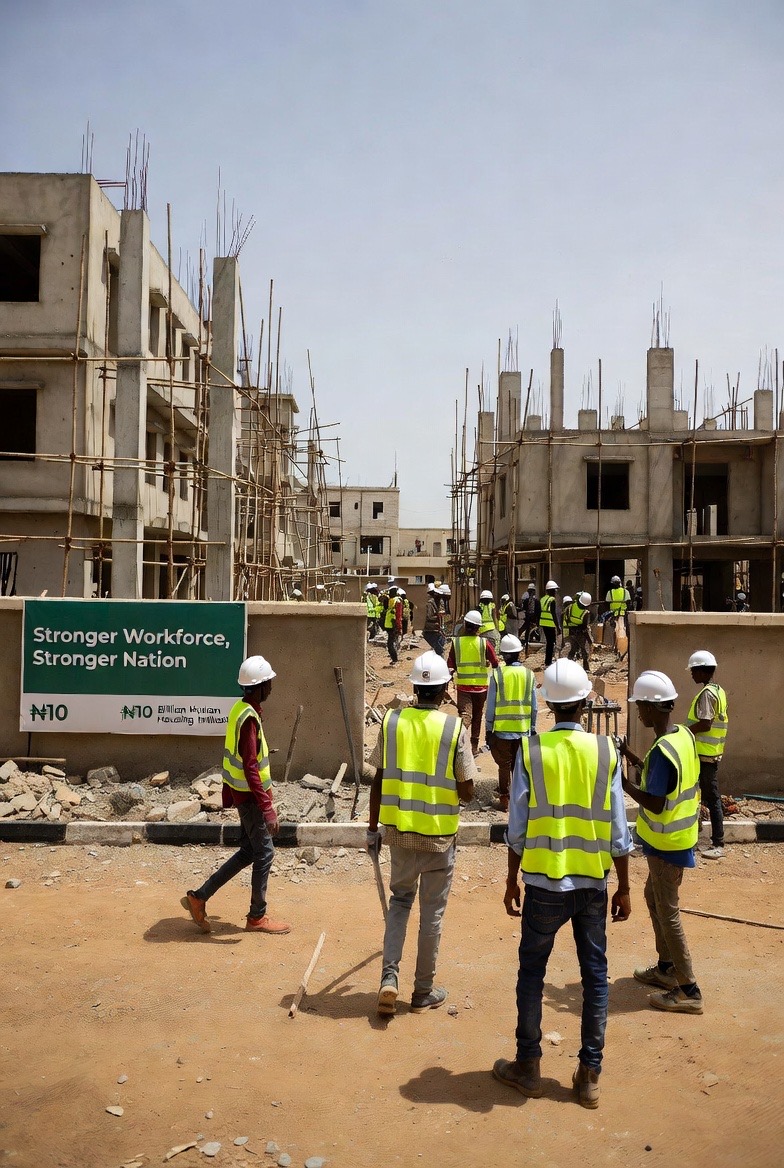
‘Stronger Workforce, Stronger Nation’: Inside the ₦10 Billion Housing Initiative Reshaping Civil Servant Welfare in Nigeria
Summary
The Federal Government of Nigeria has approved a ₦10 billion housing loan scheme for federal civil servants, unveiled on Friday, April 24, 2026 by the Head of the Civil Service of the Federation, Mrs. Didi Esther Walson Jack, ahead of the 2026 Workers’ Day celebration. The initiative to be implemented through the Federal Mortgage Bank of Nigeria and the Federal Government Staff Housing Loans Board, sealed by a formal Memorandum of Understanding is positioned not merely as a welfare package but as a strategic reform tool designed to boost workforce stability, productivity, and national development. The announcement was accompanied by a sweeping bundle of additional civil servant benefits, including enhanced pension provisions, full duty tour allowances, and an expanded employee compensation scheme the most comprehensive public sector welfare upgrade in recent memory.
In the days leading up to Nigeria’s Workers’ Day on May 1, 2026, the Federal Government has delivered what officials are calling its most substantial commitment to the welfare of public servants in years. Central to the initiative is the approval of a ₦10 billion housing loan scheme aimed at expanding access to affordable home ownership for public servants, alongside other welfare measures designed to improve their quality of life and financial security.
The announcement was made on Friday, April 24, 2026 by the Head of the Civil Service of the Federation, Mrs. Didi Esther Walson-Jack, who stated that President Bola Ahmed Tinubu’s administration has fundamentally shifted the welfare of civil servants from rhetoric to reality. Speaking at a joint press conference with the Federal Mortgage Bank of Nigeria, National Pension Commission, and other relevant agencies in Abuja, Walson-Jack struck a tone that was equal parts celebratory and visionary framing the initiative not as charity extended to a struggling workforce, but as an investment in the engine room of national governance.
The Head of Service was emphatic that the programme is not simply a welfare intervention. “What you are witnessing is not simply a welfare package; it is a philosophy,” she said, noting that a well-supported workforce is critical to achieving a high performing public service. That framing housing as governance philosophy rather than benefit was deliberate, and it sets the tone for how the Tinubu administration wants this initiative understood.
The housing loan scheme will be executed through the Federal Mortgage Bank of Nigeria and the Federal Government Staff Housing Loans Board, two key institutions responsible for facilitating access to affordable housing finance for government employees. The event marked the signing of a Memorandum of Understanding between the Federal Government Housing Loans Board and the Federal Mortgage Bank of Nigeria, designed to ease access to affordable housing loans for federal civil servants a formal institutional alignment that previous administrations had repeatedly promised but never formalised.
Under the plan, eligible civil servants will be able to access loans at single digit interest rates with flexible repayment terms. The Federal Mortgage Bank of Nigeria will provide funding to the Federal Government Staff Housing Loans Board for on lending to federal civil servants, and will offer multiple options tailored to meet the diverse housing needs of workers whether for homeownership, renovation, rent support, or incremental housing development, according to the Managing Director of the Federal Mortgage Bank, Shehu Usman Osidi.
Walson-Jack chose vivid, human language to explain what she believes the scheme will mean in practice. “There’s a saying that a person who owns their own home, they stand differently. When a civil servant knows that their family has a place they can call their own, they come to work with a different swagger,” she said an acknowledgment that the psychological and emotional dimensions of homeownership are inseparable from the professional ones.
The Managing Director of the Federal Mortgage Bank reinforced that message. “At the FMBN, we hold firmly to the belief that access to safe, decent and affordable housing is not a luxury but a necessity. It is central to dignity, productivity and national development,” Osidi said, describing the partnership with the Housing Loans Board as the dawn of a renewed commitment to improving the lives of Nigerian workers.
The housing scheme did not stand alone. Walson Jack unveiled a comprehensive welfare bundle that significantly expands civil servant entitlements across several areas. The government announced the provision of 100% of a retiring employee’s total annual emoluments to Treasury funded civil servants under the Contributory Pension Scheme, effective from January 1, 2026, in accordance with Section 44A of the Pension Reform Act 2014. Additional measures include an increase in peculiar allowance, payment of full duty tour allowance at 100% for civil servants attending approved training programmes at approved manpower development institutions, estacode, and book allowance, among others.
The reforms also include the operationalisation of the Employee Compensation Scheme, which offers financial protection to workers in cases of job related injury or death a measure long advocated by labour groups and civil society organisations as essential to the basic dignity and security of public sector employment.
Walson Jack also underscored the importance of inter-agency collaboration in driving reform outcomes, citing the roles of key government institutions including the Office of the Secretary to the Government of the Federation, the Budget Office, and the Office of the Accountant General in aligning policy implementation. “This is the power of collaboration across government institutions working in concert towards a shared national purpose,” she said.
Nigeria continues to face a significant housing deficit, estimated by sector stakeholders at over 20 million units. Expanding access to mortgage finance for salaried workers represents a critical pathway to addressing affordability constraints, and the ₦10 billion facility is expected to stimulate demand within the housing market, particularly in the formal mortgage segment. Increased uptake of housing loans could also drive activity in construction, building materials, and real estate services.
The implementation framework, including eligibility criteria and application procedures, is expected to be released in the coming weeks, with the Federal Mortgage Bank of Nigeria expected to manage disbursement in collaboration with relevant ministries and agencies.
Analysis
The ₦10 billion housing initiative arrives at a moment when Nigeria’s civil service is deeply in need of a morale signal and the Tinubu administration has delivered one, deliberately timed to the national significance of Workers’ Day. But the measure of this initiative will not be found in the press conference that launched it. It will be found in the quiet, unglamorous work of disbursement, eligibility verification, loan processing, and the speed with which an ordinary Grade Level 8 officer in Benue or Kebbi State is able to convert the government’s announcement into a set of keys. The structural foundation of the scheme is more credible than many previous attempts at civil servant housing finance in Nigeria. The Memorandum of Understanding between the Federal Government Staff Housing Loans Board and the Federal Mortgage Bank of Nigeria is not a new idea it is a long-overdue formalisation of a partnership that should have existed years ago. Its signing is significant because it creates an institutional accountability framework: two named bodies, bound by a formal agreement, with defined responsibilities for funding and disbursement. That is meaningfully different from the vague commitments that have characterised housing policy for public workers through multiple administrations. The offer of single digit interest rates is also significant in the current economic environment. Nigeria’s commercial mortgage market remains largely inaccessible to middle and lower-income earners, with lending rates that routinely exceed 25% per annum figures that make homeownership through the banking system a mathematical impossibility for most civil servants. A subsidised loan scheme operating below double digits directly addresses that barrier, though the scale of the intervention ₦10 billion against a housing deficit of 20 million units suggests that this is a beginning, not a solution. A programme of this size, divided across a federal civil service of several hundred thousand workers, will reach a relatively small fraction of those who need it. The government’s own statement that eligible criteria and application procedures will be released in coming weeks is a reminder that the operational machinery of delivery has not yet been fully assembled. The broader welfare package particularly the 100% terminal benefit enhancement and the operationalisation of the Employee Compensation Scheme speaks to a more comprehensive understanding of what it means to be a responsible employer. For too long, Nigeria’s federal civil service has suffered from a dual affliction: being asked to deliver high-quality governance while being paid too little, housed insecurely, and protected inadequately against the occupational risks of public work. If these measures are implemented fully and consistently, they represent a genuine improvement in the social contract between the Nigerian state and its workforce. The sceptic’s question and it is a fair one is whether this administration has the implementation discipline to match its announcement ambition. Nigeria has launched housing schemes for civil servants before. Many were swallowed by bureaucratic inertia, elite capture, or fiscal constraints before they reached the intended beneficiaries. What is different this time, if anything, must be demonstrated in delivery rather than declared in speeches. Workers’ Day is the right moment for bold commitments. The months that follow will determine whether those commitments deserve to be remembered.
Tags