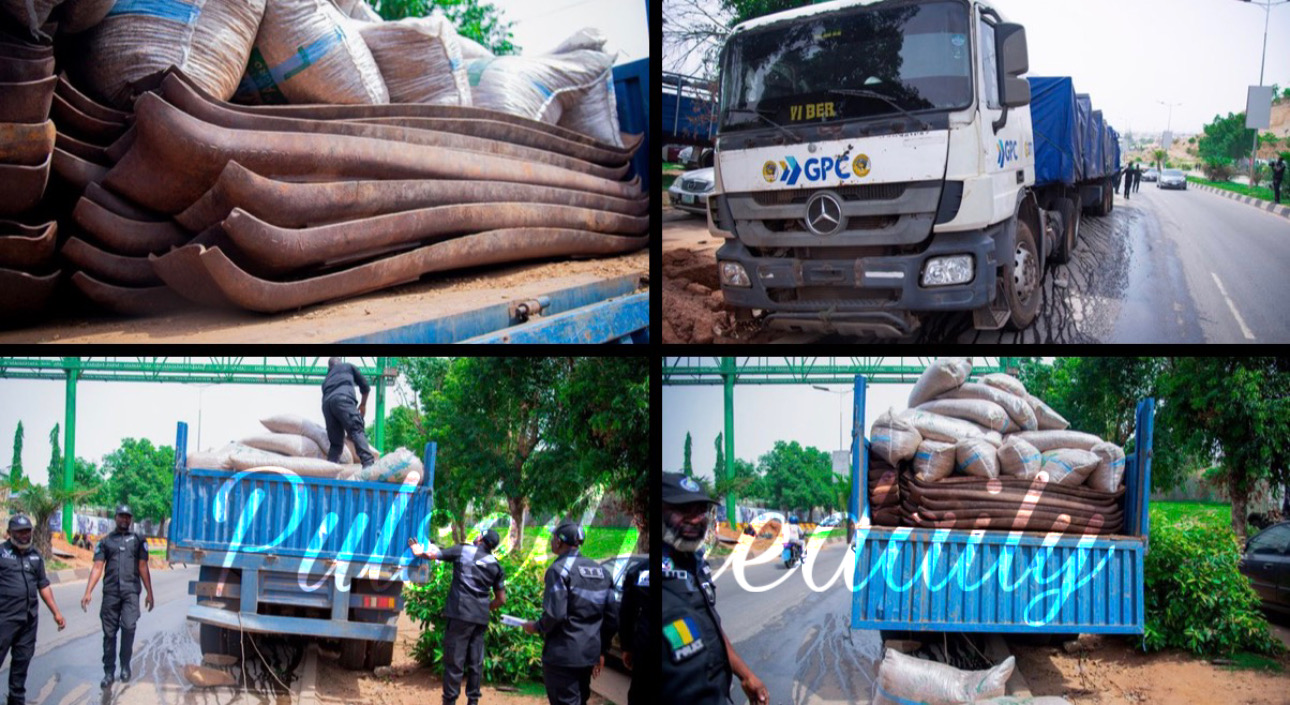
They Turned Down ₦100 Million: How NPF’s FID-STS Dismantled a Railway Vandalism Syndicate and Recovered ₦400 Million in Stolen Infrastructure
Summary
The Nigeria Police Force, through its Force Intelligence Department Special Tactical Squad (FID-STS), has arrested two suspects Chisom Goodnews (32) and Ahmed Adamu (22) and recovered vandalised railway tracks and sleepers valued at over ₦400 million in Akwanga, Nasarawa State. The operation, conducted on April 9, 2026 under the command of ACP Victor Ogbeide Godfrey, intercepted a trailer truck concealing approximately 60 tonnes of stolen railway infrastructure beneath sacks of groundnut shells. The materials were being transported from Bauchi State to Ilorin, Kwara State, as part of what investigators describe as a well-coordinated supply chain involving railway vandals, transporters, and organised receivers. In a remarkable display of integrity, the operatives involved rejected a ₦100 million bribe offered to secure the suspects’ release and compromise the investigation. Inspector-General of Police Olatunji Rilwan Disu has commended the operatives for their courage, discipline, and incorruptibility.
In an operation that combined sharp intelligence work with an extraordinary display of professional integrity, Nigeria Police Force operatives have dealt a significant blow to an organised railway vandalism syndicate and done so while flatly refusing a bribe offer that would have made many people wealthy overnight.
The Nigeria Police Force has foiled a major railway vandalism syndicate, arresting two suspects and recovering stolen infrastructure valued at over ₦400 million. The breakthrough was achieved by operatives of the Force Intelligence Department Special Tactical Squad (FID-STS). The operation was executed under the leadership of ACP Victor Ogbeide Godfrey, acting on the directive of Inspector-General of Police Olatunji Rilwan Disu to decisively tackle acts of economic sabotage.
The suspects, Chisom Goodnews (32) and Ahmed Adamu (22), were arrested on April 9, 2026 at about 1800hrs in Akwanga, Nasarawa State, following credible intelligence. What the operatives intercepted when they stopped the vehicle was a scene that illustrated, in concrete and measurable terms, the audacity of Nigeria’s railway vandalism problem. Recovered was a trailer truck with registration number KRB 355 SX, conveying railway tracks and sleepers weighing approximately 60 tonnes, cleverly concealed under sacks of groundnut shells. The camouflage was deliberate and calculated a smuggling technique designed to pass casual inspection along Nigeria’s highways while transporting tens of billions of naira worth of national infrastructure over hundreds of kilometres.
The materials were concealed under the groundnut shells in a deliberate attempt to evade detection while being transported from Bauchi State to Ilorin, Kwara State. The geographic scope of the operation spanning at least three states immediately signals that this is not the work of opportunistic local thieves, but a structured criminal enterprise with the logistical capacity to coordinate theft, loading, concealment, and long-distance delivery across state lines.
Preliminary investigations confirmed that reading. Findings revealed that the driver of the truck was contracted for the sum of ₦2.5 million to transport the vandalised materials, while further findings indicate an organised supply chain linked to receivers of such stolen infrastructure. Preliminary investigations indicate that the suspects are part of a well-coordinated syndicate responsible for the illegal removal and transportation of railway materials from Bauchi State to Ilorin, Kwara State. The intended receivers in Ilorin who investigators are now actively pursuing represent the demand side of a criminal market that has steadily hollowed out Nigeria’s rail infrastructure for years.
The Bribe That Was Refused
The most striking element of the entire operation is not the size of the recovery though ₦400 million in vandalised railway materials is itself an extraordinary haul. It is what happened during the investigation: an offer of ₦100 million was made to the operatives involved, in a direct attempt to compromise the process and secure the release of the suspects and the seized exhibits. The operatives refused. Every last naira of it.
Officers of the Nigeria Police Force reportedly rejected a ₦100 million bribe while foiling the railway vandalism syndicate. To put that figure in context: ₦100 million represents more than most Nigerians will earn in multiple lifetimes. The decision by operatives who are not highly paid by any standard to turn down that sum in order to uphold their duty is not a routine act. It is an act of institutional courage that deserves to be named and celebrated as such.
IGP Olatunji Rilwan Disu commended the operatives for their courage, discipline, and incorruptibility, noting that such conduct exemplifies the core values of the Nigeria Police Force. The commendation carries particular weight given the frequency with which Nigerian law enforcement has been criticised often justifiably for susceptibility to corruption. In this instance, the operatives demonstrated that the criticism, however deserved elsewhere, does not apply universally.
The Wider Context: Railway Vandalism as Economic Sabotage
The operation must be understood against the backdrop of a crisis that has been systematically destroying one of Nigeria’s most important infrastructure investments. Nigeria’s rail network including the Abuja-Kaduna standard gauge line, the Lagos-Ibadan railway, and the Eastern corridor lines has been targeted repeatedly by vandals who strip tracks, sleepers, signalling equipment, and overhead cables for sale as scrap metal. The FID-STS operation was coordinated following the expressed directive of IGP Disu to tactical teams to arrest vandals of government properties an acknowledgment at the highest level of the Force that this form of economic sabotage has become a structured security priority rather than an isolated enforcement matter.
The Nigerian Railway Corporation and the Federal Ministry of Transportation have previously estimated that vandalism-related losses run into billions of naira annually, causing service disruptions, safety hazards, and spiralling repair costs that divert resources from expansion and maintenance. When 60 tonnes of railway tracks disappear from the Bauchi corridor in a single consignment loaded, concealed, and dispatched toward Kwara State under a cover of groundnut shells the damage is not merely financial. It is a direct assault on the country’s capacity to move people and goods efficiently, safely, and affordably.
The trailer truck used for conveyance, with registration number KRB 355 SX, has been recovered and is currently in police custody. Investigations are ongoing to identify and apprehend other members of the syndicate, particularly the intended receivers in Ilorin, as well as to determine the full extent of the network’s operations across the states involved.
Analysis
The NPF’s railway vandalism bust in Akwanga is significant on two distinct levels one operational, one moral and both deserve serious attention. On the operational level, the interception of 60 tonnes of vandalised railway materials in a single operation represents exactly the kind of outcome that Nigeria’s security architecture is supposed to produce but rarely does at this scale. The fact that the FID-STS was able to act on credible intelligence quickly enough to intercept a moving trailer truck carrying concealed contraband across a multi-state route speaks to a genuine improvement in the unit’s tactical intelligence capability. Railway vandalism syndicates are not easily disrupted they operate across wide geographies, involve multiple layers of actors from the initial thieves to the final receivers, and rely heavily on corruption to keep their supply chains open. The Akwanga operation hit the middle link of that chain. Catching the receivers in Ilorin would hit the demand end. Identifying who commissioned the original vandalisation in Bauchi would close the circle entirely. That brings us to the moral dimension and the ₦100 million bribe. It is impossible to overstate what this number represents in the context of Nigerian policing. The Nigeria Police Force is chronically underfunded, its officers often work without adequate equipment, and the salary structure across the force does not reflect the risks its members take or the responsibilities they carry. Into that environment came an offer of ₦100 million enough to change a family’s circumstances for generations. The operatives said no. That decision should not be allowed to pass as a footnote in a press release. It should be treated as a defining institutional moment, celebrated loudly, and used as the foundation for a broader conversation about what it means to build a police force that Nigerians can genuinely trust. There is also a policy dimension that this operation illuminates. The railway vandalism economy exists because there is a functioning market for stolen infrastructure components scrap dealers, metal processors, and construction firms that ask too few questions about the origin of the materials they purchase. Enforcement at the point of transportation, as the FID-STS has demonstrated, is necessary. But it is not sufficient. Nigeria will continue to lose its railway infrastructure to organised vandalism until the receiving end of the supply chain the buyers and processors of stolen metal faces consequences as serious as those now being imposed on the transporters. The intended receivers in Ilorin remain at large. Their identification and prosecution would send a message that this operation, however impressive, has only begun to deliver.
Tags