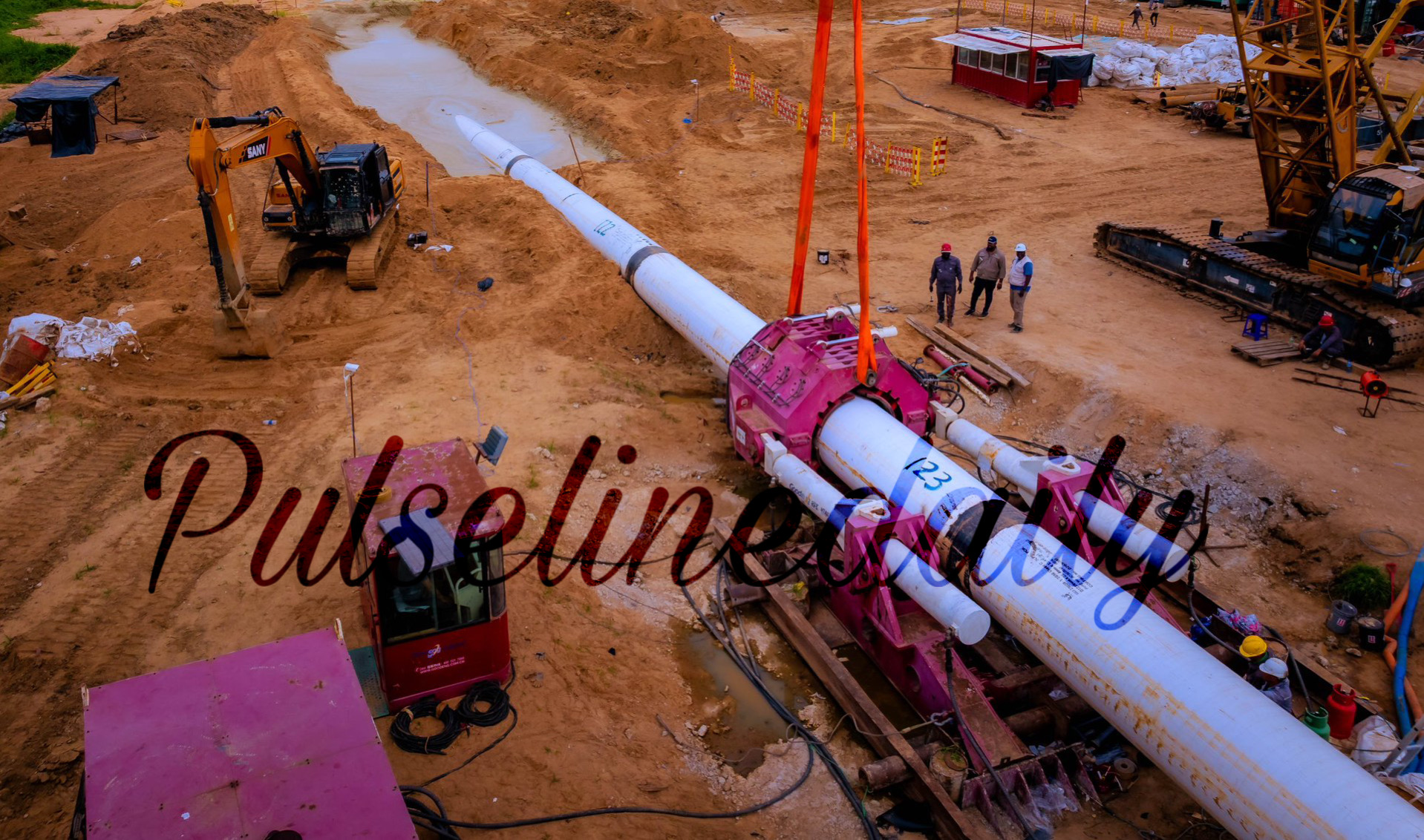
A Decade in the Making: NNPC’s NGIC Completes River Niger Crossing on OB3 Pipeline, Unlocking Nigeria’s East-West Gas Revolution
Summary
The NNPC Gas Infrastructure Company (NGIC), a wholly owned subsidiary of NNPC Limited, has successfully completed the River Niger Crossing of the 130 kilometre Obiafu Obrikom Oben (OB3) Gas Pipeline one of the most technically complex and long-delayed infrastructure milestones in Nigeria’s energy history. The crossing, which required tunnelling a 48 inch pipe beneath the riverbed between Ndoni in Rivers State and Aboh in Delta State, defeated multiple previous technological attempts over nearly a decade before finally being completed using advanced micro-tunnelling and direct pipe installation technology. The OB3 pipeline serves as the critical inter connector linking Nigeria’s Eastern gas pipeline network to the Escravos-Lagos Pipeline System in the West and the Ajaokuta-Kaduna-Kano pipeline in the North and its completion is expected to unlock up to 2.2 billion standard cubic feet of gas per day into Nigeria’s national transmission network.
Some infrastructure victories are administrative. Others are engineering conquests. The completion of the River Niger Crossing on the OB3 Gas Pipeline belongs firmly in the second category a hard won technical achievement against a section of project that defeated every previous attempt made over nearly a decade, humbled multiple contractors, and stood as the single most stubborn obstacle between Nigeria and one of its most consequential gas infrastructure breakthroughs.
The NNPC Gas Infrastructure Company, a wholly owned NNPC Limited subsidiary, has now officially completed that crossing driving a 48 inch pipeline beneath the River Niger between Ndoni in Rivers State and Aboh in Delta State, and in doing so, closing the final gap in the 130 kilometre Obiafu Obrikom Oben Gas Pipeline. The original construction contractor, the Nigerian firm Nestoil, had been technically incapable of building the portion of the pipeline running under the Niger River, trying and failing five times in 2018 and 2019 alone. What followed was years of technological iteration, contractor changes, and fresh attempts before the eventual deployment of micro tunnelling and direct pipe installation technology finally produced the breakthrough.
The OB3 Gas pipeline is designed to connect the Eastern gas pipeline network to the Escravos-Lagos Pipeline System in the West and the Ajaokuta-Kaduna-Kano Pipeline in the North a three way interconnection that transforms the pipeline from a regional gas conduit into a genuinely national one. When fully operational, the OB3 will allow gas produced in Rivers State and the Eastern Niger Delta to flow westward to fuel industry and power generation in Lagos and the South West, and northward through the AKK corridor to serve the industrial and energy needs of Kogi, Kaduna, and Kano.
“Once completed, we will see about 2.2 billion standard cubic feet of gas coming into our network,” NNPC’s leadership had projected a volume that, at current gas prices and demand levels, represents a transformative addition to Nigeria’s domestic gas supply. The significance of that figure extends well beyond the energy sector: manufacturers chronically starved of gas for industrial power generation, fertiliser producers dependent on gas feedstock, and power plants running below capacity due to inadequate gas supply will all feel the downstream impact of 2.2 billion standard cubic feet per day flowing reliably through a completed national grid.
The completion of the River Niger Crossing also matters in the context of the ANOH gas project. The original plan was to evacuate over half of ANOH gas into the Nigerian market through the OB3 pipeline, but the eastern part of the pipeline, under construction since 2014, had remained uncompleted forcing the ANOH Gas Processing Company to route gas through alternative channels to Indorama’s petrochemical plant instead. With the crossing now complete and the OB3 ready for full commissioning, the pathway for ANOH gas to reach the domestic market through its originally intended route is now open an alignment that could significantly accelerate the monetisation of Eastern Niger Delta gas reserves.
The completion is a headline achievement in NNPC Limited Group CEO Engr. Bashir Bayo Ojulari’s one year performance report, which cited the OB3 River Niger crossing alongside the ANOH OB3 pipeline commissioning and the AKK River Niger crossing as key infrastructure milestones under his leadership. It also forms part of the broader gas supply expansion that delivered 7.5 billion standard cubic feet per day to Nigeria’s network in 2025 a figure NGIC is now positioned to build upon significantly.
Analysis
The completion of the River Niger Crossing is the kind of achievement that deserves more than a press release it deserves to be understood in terms of what it actually took. The original construction contractor failed five times. The project missed completion deadlines in 2018, 2019, 2020, 2021, and beyond. It sat as the single uncompleted section of a 130-kilometre pipeline for years, holding hostage the gas supply potential of an entire regional network. That it has now been completed is a testament not just to the technology deployed, but to the institutional determination to keep trying where others had stopped. For Nigeria’s gas sector, the OB3’s completion is the infrastructure equivalent of connecting the last segment of a ring road. The Eastern pipeline network has long been physically isolated from the Western and Northern pipeline systems meaning that gas produced in Rivers State could not flow to manufacturers in Ogun, power stations in Kano, or fertiliser plants in Lagos without being routed through more expensive or less efficient alternatives. The OB3 bridges that gap permanently, creating for the first time a genuinely integrated national gas transmission system capable of moving Eastern reserves to wherever domestic demand is highest. The broader implication particularly in the context of Nigeria’s commitment to gas as a transition fuel toward energy security and industrialisation is that the country’s most critical gas infrastructure bottleneck has been removed. What happens next depends on the pace of upstream production, the commercial framework governing gas sales, and the ability of the AKK pipeline to complete its own northern corridor. But the River Niger has been crossed. That is not a small thing.
Tags