From Algiers to Malabo: Pope Leo XIV’s Landmark Africa Journey of Peace and Diplomacy
Summary
Pope Leo XIV, history’s first American pope, completed a landmark 11 days apostolic journey across four African nations Algeria, Cameroon, Angola, and Equatorial Guinea from April 13 to 23, 2026. The trip, his first to Africa since his election in May 2025, was defined by historic firsts, powerful symbolic gestures, and unsparing calls for peace, justice, and the fair distribution of Africa’s vast natural resources. He departed from Malabo, Equatorial Guinea, on April 23, returning to Rome after covering more than 11,000 miles across 18 flights.
When Pope Leo XIV’s papal plane lifted off from Rome’s Leonardo Da Vinci Airport on the morning of April 13, 2026, it carried more than just a pontiff on his first African journey it carried the weight of history. The trip was Leo’s third outside of Italy since his election in May 2025, and his first to Africa, spanning four nations across 11 cities from April 13 to 23. What followed was, by nearly every measure, one of the most consequential papal trips in modern times marked by historic milestones, raw emotion, global controversy, and an unmistakable sense that the pope had come to Africa not merely as a religious figurehead, but as a moral witness to a continent long shaped by forces beyond its control.
Algeria: A Historic First and Interfaith Dialogue
The first leg of the journey was unprecedented: Algeria had never in the history of the Catholic Church received a papal visit. The significance was amplified by the country’s demographics Algeria is a majority Sunni Muslim nation with a Catholic population of around 8,000 making Leo’s presence there a statement in itself about the importance of interfaith encounter. He was greeted by Algerian President Abdelmadjid Tebboune with a full state welcome, including a guard of honour, 21 gun salute, and the playing of both national anthems.
Among the most striking moments of the Algeria leg was Leo’s visit to the Great Mosque of Algiers the third-largest mosque in the world, featuring the world’s tallest minaret at approximately 265 metres where he met with the mosque’s rector and other religious leaders as a gesture of interfaith dialogue. Reflecting on the visit from the papal plane, Leo said: “I think the visit to the mosque was significant and showed that although we have different beliefs, we have different ways of worshipping, we have different ways of living, we can still live together in peace.”
Pope Leo also made a deeply personal stop in Annaba the ancient city of Hippo, where Saint Augustine served as bishop from 396 to 430 AD. As a member of the Augustinian Order, the visit amounted to a return to the very roots of his faith and vocation. Despite pouring rain, the pope walked through the ruins and laid a wreath of flowers, visibly moved. He also paid homage to migrants killed in shipwrecks trying to reach Europe a gesture directed at one of the defining tragedies of modern Africa’s relationship with the West.
Cameroon: A Plea for Peace in a War Scarred Region
Leo’s visit to Cameroon intersected directly with the ongoing Anglophone Crisis a separatist conflict that has plagued the country’s English speaking western regions since 2017. Notably, several Ambazonian militant groups announced a temporary ceasefire to allow safe travel for the pope and pilgrims the first such ceasefire after nearly a decade of conflict.
The defining moment of the Cameroon leg came in Bamenda, the epicenter of the conflict. At a peace meeting there, Leo blasted the “handful of tyrants” who are ravaging the planet with war and exploitation remarks that reverberated far beyond the region’s separatist conflict and triggered days of controversy when commentators suggested, and Leo later denied, that the words were directed at US President Donald Trump. He released a dove at St. Joseph’s Cathedral in Bamenda, kneeling inside the cathedral in a moment of solemn prayer.
In Yaoundé, Leo visited the Ngul Zamba Orphanage, where he was welcomed with songs and dances by children who had known abandonment, loss, and fear. He told them: “You are called to a future that is greater than your wounds.” He later celebrated Mass in Douala, urging young people to resist the temptation of corruption.
Angola: Confronting the Ghosts of Slavery and Exploitation
In Angola, where around 58% of the population is Catholic, Leo prayed at the Sanctuary of Mama Muxima a Marian shrine that is one of Angola’s most important Catholic pilgrimage sites, but also a place deeply linked to the history of slavery. Built in the 17th century by Portuguese colonisers, it became a key point in the trans-Atlantic slave trade, where enslaved people were baptised before being shipped to the Americas.
The visit carried particular personal resonance. Research conducted last year revealed that the first American pope has both Black and white ancestors who include enslaved people and slave owners a fact that hung over the visit with quiet but unmistakable weight. The crowd erupted into applause when Leo addressed the gathering in Kimbundu, a Bantu language spoken in Angola, saying: “Mama Muxima, tueza kokué, Mama Muxima, tutambululé” meaning: “Mother of the heart, we come to you; Mother of the heart, receive us.”
At a meeting with Angolan President Joao Lourenco, Leo challenged the country’s leadership to break the “cycle of interests” that have exploited Africa and its people for centuries a direct call to accountability in a country rich with oil and diamonds, yet where more than 30% of the population lives on less than $2.15 a day.
Equatorial Guinea: Grace in Difficult Places
The final stop presented Leo with the most diplomatically complex terrain of the tour. Equatorial Guinea is run by Africa’s longest-serving president, Teodoro Obiang Nguema Mbasogo, who has been in power since 1979 and faces widespread accusations of corruption and authoritarianism. Yet it was here that some of the trip’s most human moments occurred. Leo broke away from a choreographed visit to a psychiatric hospital in Sampaka to greet patients individually and pose for selfies a spontaneous act that captured something essential about his pastoral instinct.
He also visited the Bata penitentiary a prison long known for harsh conditions and told more than 600 inmates that “no one is excluded from God’s love,” urging them to see even behind bars the possibility of change, reconciliation, and hope.
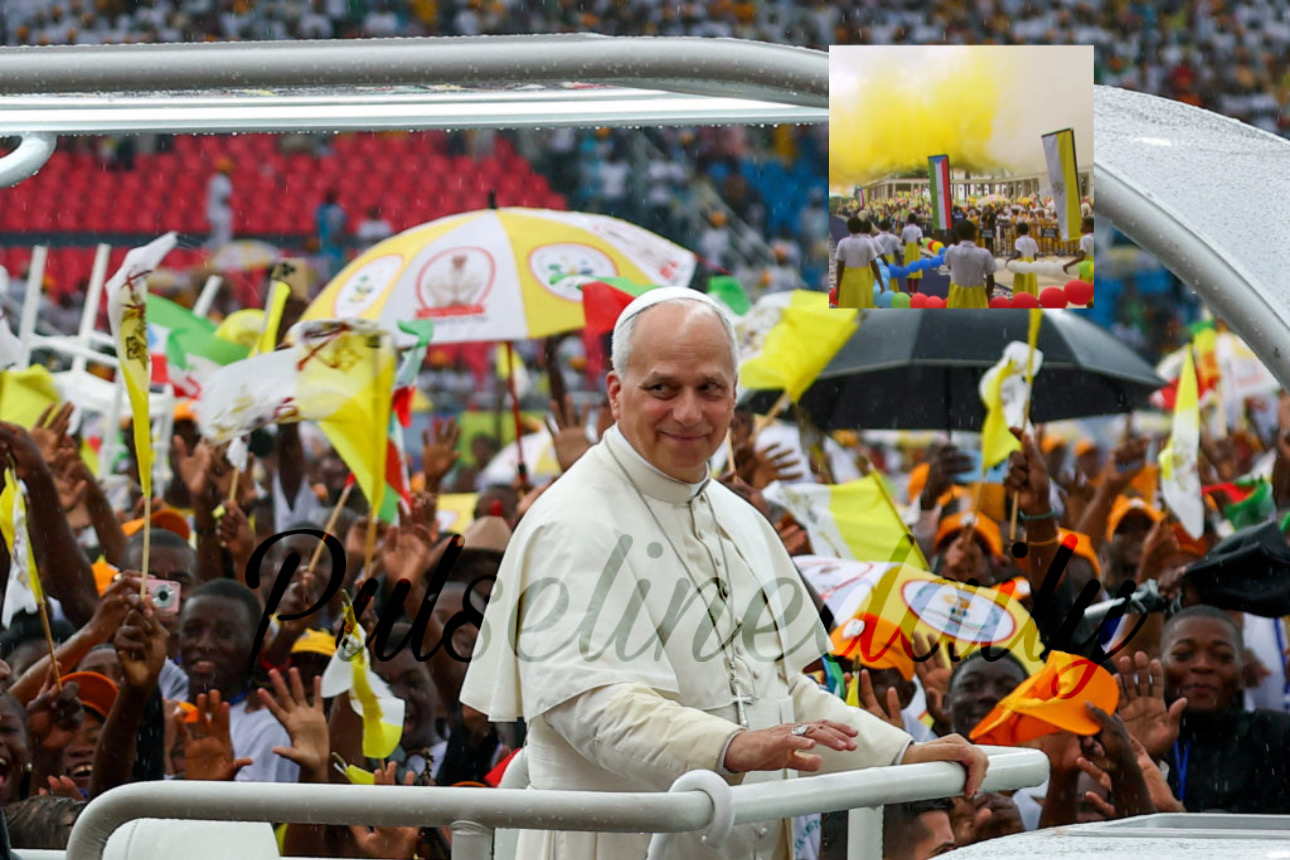
The trip concluded with a farewell Mass at Malabo stadium, where an estimated 30,000 faithful gathered before dawn in a powerful rainstorm that let up just before Leo arrived in his popemobile. He departed from Malabo airport on April 23, ending the 11-day, four-nation journey.
Analysis
Pope Leo XIV went to Africa carrying a message, and Africa gave it back to him amplified. What the trip demonstrated above all else is that this is a pontiff who understands the difference between pastoral presence and diplomatic performance and who is willing to blur the lines between them when the moment demands it. From kneeling in the rain at Hippo to greeting psychiatric patients one by one, to speaking a few sentences of Kimbundu that brought a crowd to its feet, Leo’s Africa trip was a masterclass in the kind of leadership that operates through encounter rather than proclamation. The theological themes of the journey were clear: interfaith coexistence in Algeria, peace in Cameroon, healing from slavery and exploitation in Angola, and human dignity in Equatorial Guinea. But what connected them all was a single, insistent thread that Africa’s suffering is not accidental, but structural, and that the Church has a responsibility to name that clearly. Leo’s challenge to Angolan leaders to break the “cycle of interests” that have exploited the continent, his blast at the “handful of tyrants” in Bamenda, his visit to a notorious prison to tell inmates that God’s love excludes no one these were not the gestures of a pontiff content to offer comfort without accountability. The backdrop of his public feud with President Trump over the Iran war added an unexpected layer of political significance to the journey. That the leader of the Catholic Church found himself engaged in a transatlantic war of words with the American president while travelling through four of the world’s most resource exploited nations was, whether intentional or not, deeply resonant. Africa has long been the site of precisely the kind of geopolitical interests Leo was preaching against and his refusal to stay quiet, even under pressure from the world’s most powerful government, communicated something important to the tens of thousands who came out to see him. The historic dimension of the trip cannot be overstated either. Algeria had never received a pope. Leo became the first pontiff to set foot on its soil, in a nation where Catholics number just 8,000 in a population of 45 million and he went to their mosque anyway. That single act of entering the Great Mosque of Algiers as an act of respect said more about Leo’s understanding of the Church’s role in the world than any homily could. His Africa journey was not just a pastoral visit. It was a statement of intent.
Tags