'No Case in Nigeria' — NCDC Issues Hantavirus Alert as Deadly Cruise Ship Outbreak Spreads Across the Atlantic
Summary
Nigeria's Centre for Disease Control and Prevention has issued a public health advisory on hantavirus assuring Nigerians that no case of the disease has been detected in the country, while placing the public on alert following a growing international outbreak linked to a cruise ship crossing the Atlantic. The advisory, signed by NCDC Director General Dr. Jide Idris on Friday, May 8, 2026, was triggered by reports of a hantavirus cluster tied to international cruise ship travel involving passengers and crew from multiple countries. The Dutch flagged vessel MV Hondius, which departed Ushuaia, Argentina in late March, had recorded seven cases two laboratory confirmed and five suspected including three deaths as of May 4, 2026.
Nigeria has not recorded a single hantavirus case. But the NCDC is not waiting for that to change before acting.
"The Nigeria Centre for Disease Control and Prevention is aware of recent reports of an ongoing hantavirus cluster linked to cruise ship travel involving multiple countries," the agency's advisory stated. "There is no evidence of hantavirus cases in Nigeria." The advisory was deliberately calm in tone but its timing was not accidental. Around the world, health authorities are watching the MV Hondius situation with rising concern.
The Dutch flagged cruise vessel departed Ushuaia in Argentina in late March 2026, carrying 147 passengers and crew from multiple nationalities on a transatlantic voyage. By May 4, it had reported seven cases linked to hantavirus two confirmed in a laboratory and five suspected with three deaths recorded. Cape Verde refused the ship permission to dock. Spain's Canary Islands expressed strong opposition to allowing it port entry despite some national level deliberations. The ship, in short, has become a floating health crisis that no country wants to deal with up close.
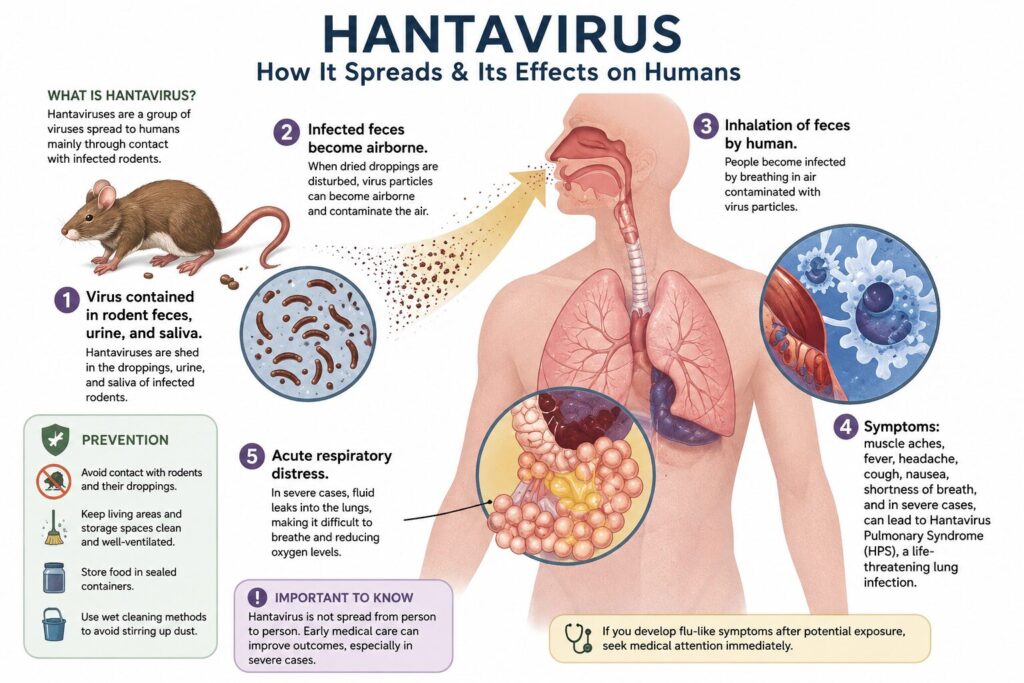
The current cluster has been linked to the Andes virus strain one of the few hantavirus strains for which limited human tohuman transmission has previously been documented, particularly through close contact. That detail is what is making global health authorities especially cautious. Most hantavirus strains spread only from animals to humans rodents to people, through contact with urine, droppings, saliva, or contaminated dust. The Andes strain adds a layer of complexity that the others don't carry.
Hantavirus symptoms include fever, fatigue, body aches, headache, and gastrointestinal distress. In severe cases, the infection can progress to breathing difficulties and life-threatening respiratory complications. There is no specific approved cure or vaccine. Treatment is supportive managing symptoms while the body fights the infection. That combination of no treatment, high severity in serious cases, and a strain with documented person to person spread is why a cluster of seven cases on a single ship has prompted health advisories across multiple continents.
Dr. Jide Idris made clear that Nigeria's surveillance systems remain active and that the agency will continue monitoring global developments. "At this time, there is no evidence of hantavirus cases in Nigeria. NCDC is closely monitoring the situation and maintaining surveillance for emerging infectious diseases," he said.
The practical guidance offered to Nigerians is grounded in the basic science of how the disease spreads. The NCDC advised Nigerians to maintain clean environments, prevent rodent infestation, store food properly and dispose of waste safely, avoid contact with rodents and their droppings, use appropriate protective measures when cleaning rodent infested areas, practise regular hand hygiene, and maintain optimal infection prevention practices in communities and healthcare settings. None of it is complicated. But in a country where rodent infestation is a daily reality for millions of households particularly in urban neighbourhoods with poor waste management infrastructure none of it is trivial either.
The NCDC also urged Nigerians to rely only on verified information from official public health authorities, specifically to avoid misinformation as global attention on the outbreak grows.
Analysis
The NCDC's handling of this advisory is, on balance, measured and appropriate. The message is clear: no case in Nigeria, risk is low, but stay alert and take basic precautions. That's the right posture for a health authority responding to an international outbreak that has not yet touched its shores. It's neither alarmist nor dismissive. It's responsible. But the advisory also quietly exposes a vulnerability that Nigeria should not take lightly. The MV Hondius cluster is a cruise ship story a disease moving through a contained environment of international travellers crossing the Atlantic. Nigeria has three major international airports processing thousands of passengers daily from South America, Europe, and West Africa. The ship's route alone from Argentina through the Atlantic to potential docking points in Europe and the Canaries traces a geography that intersects with regular travel patterns into Nigeria. If a passenger on that ship or in contact with someone from it boards a connecting flight to Lagos or Abuja, the situation changes. The Andes strain's capacity for limited human to human transmission is the detail that deserves the most public health attention. Most discussions of hantavirus describe it primarily as a zoonotic disease animal to human. The Andes variant rewrites that slightly, and in an environment like Nigeria where healthcare seeking behaviour is often delayed, symptoms like fever, fatigue, and body aches are easily attributed to malaria or typhoid. A hantavirus case, if it arrived in Nigeria today, could circulate undetected for days before the right diagnostic question was even asked. That's not a hypothetical designed to cause panic. It's a structural reality that the NCDC's surveillance systems need to be specifically calibrated to address. Nigeria's rodent problem adds a separate but related dimension. Hantavirus is, at its core, a disease of environments where humans and infected rodents share space. Millions of Nigerians live in exactly those conditions homes where food storage is compromised, waste disposal is irregular, and rodents are a daily nuisance rather than an occasional visitor. The NCDC's preventive guidance is sound. The challenge is that for many households, following it fully is a matter of access and infrastructure, not just awareness. Clean environments and proper waste disposal are harder to maintain when your neighbourhood hasn't had a functional waste management system in years. The NCDC deserves credit for acting proactively this advisory came before any case was detected, not after. That's the public health lesson COVID 19 should have taught every country, and it appears Nigeria's health authorities have internalised at least part of it. The next test is whether the surveillance infrastructure behind the advisory is as robust as the advisory itself. Because when it comes to emerging infectious diseases crossing borders on cruise ships and aircraft, the gap between a press release and actual preparedness is often the most important distance to measure.
Tags